CSED Verification: Why the IDRS Date Isn't Always the Real Date
This is a subtitle for your new post

Every tax assessment carries a Collection Statute Expiration Date—ten years from the assessment under IRC 6502 — unless something suspends or extends it. The IRS's own manual is blunt about the reliability problem: IRM 5.1.19.6(3) states directly that the CSED reflected on ICS and IDRS may not always be correct. That's not a taxpayer-side complaint — it's the agency's own collection policy, and it's why CSED verification is its own IRM section rather than something a revenue officer just reads off a screen.
The Ten-Year Clock and What Actually Stops It
IRM 5.1.19.1.1 establishes the baseline: the collection statute ends the government's right to pursue collection once ten years have run from assessment. What complicates the calculation is the list of case actions in IRM 5.1.19.3 that suspend or extend that clock. The ones that come up most often in a business collection case:
- Bankruptcy — IRM 5.1.19.3.1 suspends the CSED for the period the automatic stay is in effect, plus six months, under IRC 6503(h)(2).
- Collection Due Process hearings — IRM 5.1.19.3.3 suspends the CSED from the date the IRS receives a timely CDP hearing request until the taxpayer withdraws it or Appeals' determination becomes final, including any court appeal. If less than 90 days remain when the determination becomes final, the statute is extended to equal 90 days.
- Offers in Compromise — IRM 5.1.19.3.4 suspends the CSED while an offer is pending, for 30 days after rejection, and during any timely-filed appeal of the rejection.
- Installment agreement requests — IRM 5.1.19.3.5 is worth reading carefully, because the intuitive assumption is usually wrong. The CSED is suspended while a request is pending, for 30 days after rejection or termination, and during a timely appeal — but the manual states explicitly that the CSED is not suspended while an installment agreement is in effect. An active, performing IA doesn't toll the clock; only the pending and rejection/termination windows do.
- Taxpayer outside the U.S. — IRM 5.1.19.3.7 suspends the CSED under IRC 6503(c) for any continuous absence of six months or more, and the suspension can run considerably longer than the absence itself to preserve the government's post-return collection window.
The Rule Practitioners Miss: Overlaps Don't Stack
IRM 5.1.19.3(2) contains the single most important sentence in this section for anyone doing their own CSED math: when more than one case action suspends the statute at the same time, the suspensions run concurrently — they are not cumulative. The IRM's own worked example illustrates this precisely: a taxpayer's combat-zone suspension and a later-filed OIC suspension overlap for several months, and that overlap period counts only once toward the total extension, not twice. Treating stacked suspensions as additive is a common miscalculation, and it always errs in the taxpayer's favor to assume — incorrectly — that the CSED is later than it actually is.
Verification Is Now Its Own Required Step
IRM 5.1.19.5.2 requires that imminent CSEDs — defined in 5.1.19.5(1) as anything with twelve months or less remaining — be affirmatively verified before the case is worked further, specifically by reviewing the module for suspending-event irregularities that could produce an inaccurate date. IRM 5.1.19.6 goes further and treats CSED review as an ongoing discipline, not a one-time check: pull the transcript, identify every TC code that carries or affects a CSED (the manual's own table in 5.1.19.2.2 lists TC 480 for OIC, TC 520 with its various closing codes for bankruptcy and litigation, TC 971 AC 043 for pending IAs, and TC 550 for manual waiver extensions), and reconstruct the suspension timeline manually rather than trusting the displayed date.
Why This Matters for Referral Sources
For a bankruptcy or family law attorney, the CSED calculation often turns on events that happened years earlier and aren't visible without pulling transcripts—a CDP hearing requested during a prior representation, an OIC that was filed and rejected, a stretch of time the taxpayer spent working overseas. None of that shows up in a client's casual description of "my tax debt." If a case is being evaluated for CNC, an OIC, or a PPIA and the CSED is anywhere near the horizon, the transcript pull comes first — not the resolution strategy. Get the date wrong in either direction, and the whole negotiating position built around it is wrong too.
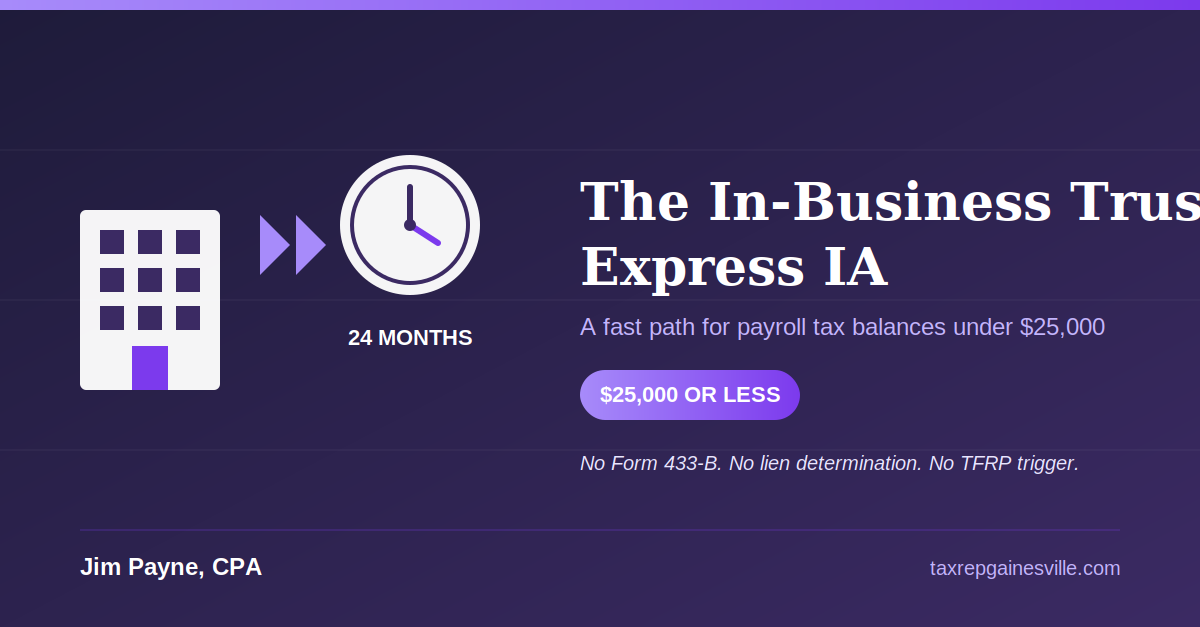
The In-Business Trust Fund Express Installment Agreement: A Fast Path for Small Payroll Tax Balances