The In-Business Trust Fund Express Installment Agreement: A Fast Path for Small Payroll Tax Balances
This is a subtitle for your new post

If your business owes $25,000 or less in payroll tax — and you can pay it off within 24 months — there's a resolution option that moves faster and asks for less paperwork than almost anything else in the collections toolbox: the In-Business Trust Fund (IBTF) Express Installment Agreement.
I see clients miss this option regularly, usually because they assume any business payroll tax case requires a full financial workup. It doesn't, if the numbers fit.
What Qualifies
- Under IRM 5.14.5.4, a business qualifies for an IBTF Express Installment Agreement when:
The Unpaid Balance of Assessments (UBA) — tax, assessed penalty, and interest combined — is $25,000 or less at the time the case is received into inventory, and
2. The liability can be full-paid within 24 months, or before the Collection Statute Expiration Date (CSED), whichever comes first.
For an In-Business Trust Fund Express Installment Agreement, the $25,000 threshold is determined by the unpaid assessment balance at the time the case is received into inventory. Under IRM 5.14.7.3.1, the taxpayer may not make payments after that point solely to reduce the UBA to $25,000 or less to qualify for IBTF Express treatment. Cases above that threshold generally must be considered under the regular BMF/IBTF installment agreement procedures, which may require financial analysis and TFRP consideration. This is different from other installment agreements.
What the IRS Does *Not* Require
This is where the Express agreement earns its name. Per IRM 5.14.7.3, when a business qualifies for IBTF Express:
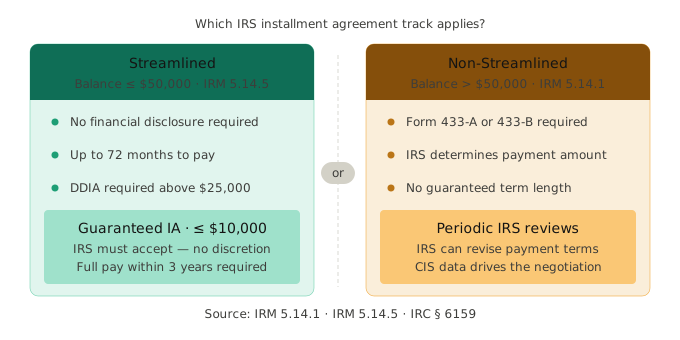
1. No Form 433-B is required. The IRS skips the full Collection Information Statement for the business.
2. No TFRP investigation is triggered as a condition of the agreement. IBTF Express agreements do not require Trust Fund Recovery Penalty consideration or cross-compliance checks on officers, partners, or LLC members, as they would under a standard business IA (IRM 5.14.7.4.1).
3. No lien determination is required. IRM 5.14.5's cross-reference to IRM 5.12.2.3.1 confirms a Notice of Federal Tax Lien filing determination isn't mandatory for IBTF Express cases — though a revenue officer retains discretion to file one if the business has defaulted on a prior IA within the current or preceding calendar year.
For a client who's current on everything else and just fell behind on a single quarter or two of payroll tax, this is about as close to a rubber stamp as IRS collections gets.
Where It Breaks Down
The moment a case doesn't fit — balance above $25,000, or can't be paid off in 24 months — you're back to a standard in-business installment agreement under IRM 5.14.7.3, which does require:
1. A full Form 433-B and financial analysis: verifying income and expenses against bank statements, checking equity in real and personal property, and evaluating whether assets should be borrowed against or liquidated before an IA is granted.
2. A compliance check on the individual filing history of corporate officers, partners, and LLC members — not just the business entity (IRM 5.14.7.3.1).
3. TFRP consideration. IRM 5.14.7.4.1 directs the revenue officer to consider a Trust Fund Recovery Penalty assessment whenever an installment agreement won't fully satisfy the trust fund liability, and to secure a Form 2750 waiver extending the assessment statute where the trust fund portion isn't yet time-barred (IRM 5.7.4.8.1).
This is the fork in the road I walk clients through early: a case that's a clean $22,000 payroll tax balance the owner can clear in 18 months is a different conversation — and a much faster one — than a $60,000 balance stretching past two years.
Two Clocks Worth Watching
Even on an Express agreement, two separate statutes are running:
1. The business's CSED on the underlying payroll tax assessment.
2. If TFRP is ever assessed against a responsible individual (which Express agreements are specifically designed to avoid triggering), that penalty runs on its own 10-year clock, separate from the business's.
Business owners often assume that once the company debt is handled, their personal exposure is automatically resolved. It isn't, once TFRP has actually been assessed. Staying inside Express-agreement territory is one of the cleanest ways to avoid that assessment altogether — which is a good reason not to let a case drift past the $25,000 line if it can be avoided.
Bottom Line
If you're a business owner with a payroll tax balance under $25,000 that you can pay off in two years, ask specifically about the IBTF Express agreement before assuming you need a full financial disclosure process. It's the fastest, least invasive resolution the IRS offers for in-business trust fund debt — but the eligibility window is narrow and the IRS won't let you engineer your way into it after the fact.
If your situation is more complicated than that — larger balance, longer payoff, prior defaults — I can help you work out which path actually fits, and what it will take to get there.
*If you or someone you know is dealing with payroll tax debt or has received a Notice of Intent to Levy, contact me at [taxrepgainesville.com](https://taxrepgainesville.com), (352) 317-5692, or jim@taxrepgainesville.com.*