Currently Not Collectible Status: What It Means When the RO Closes a Business Account
This is a subtitle for your new post

When a corporate or LLC tax liability lands in CNC status, it's rarely a hardship determination — it's a decision the revenue officer makes in the course of working the collection case, usually alongside a trust fund recovery penalty investigation. The RO has looked at the business's assets, its receivables, and its ability to pay current taxes, and concluded there's nothing to distrain and no basis to expect the liability will shrink. Understanding what that closure does and doesn't mean matters for how you advise a client whose business ends up there.
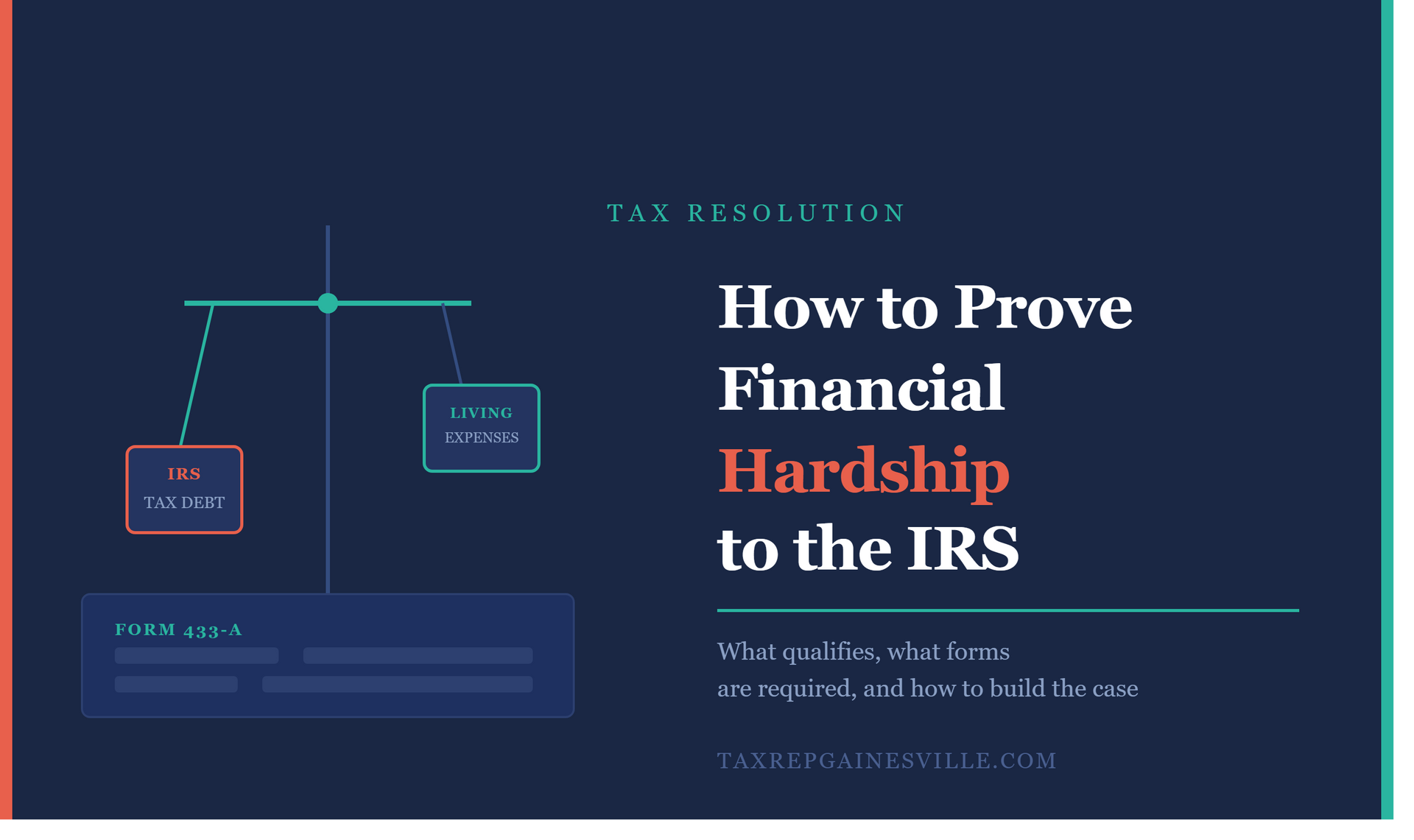
Hardship CNC and in-business CNC are two entirely different classifications under the IRM, with different qualifying criteria and different consequences.
Two Kinds of CNC, Not One
IRM 5.16.1.2.9 governs hardship CNC — closing codes 24 through 32. This classification exists when collection would leave the taxpayer unable to meet basic living expenses. Critically, the IRM is explicit that hardship closing codes can only be used for individual or joint IMF assessments, sole proprietorships, and partnerships where a general partner is personally liable. A corporation or LLC where the entity itself is the liable taxpayer does not qualify for hardship CNC. There's no "hardship" concept for an entity — corporations don't have basic living expenses.
For an operating corporation, exempt organization, or LLC that can't pay its back taxes, the relevant provision is IRM 5.16.1.2.7, In-Business Corporations, Exempt Organizations, Limited Liability Partnerships, or Limited Liability Companies — closing code 13. This is a fundamentally different test: the business must be able to pay its current taxes but be unable to pay its back taxes, and enforcement can't be taken because the business has no distrainable receivables or equity in assets.
What It Actually Takes to Get There
In-business CNC isn't a paperwork formality. Per IRM 5.16.1.2.7(3)-(4), the revenue officer has to secure a complete Collection Information Statement and verify it against the business's bank statements, financial statements, and last filed return. The income and expense analysis has to affirmatively show the business can make current deposits but genuinely cannot service the back liability. If there's equity in assets, the reason enforcement isn't being pursued has to be documented in the case history — this isn't something that gets waived because a business is struggling.
Two conditions I flag for clients every time:
- TFRP has to be resolved first. IRM 5.16.1.2.7(6) requires a completed trust fund recovery penalty investigation and an approved Form 4183 before the account can be closed as in-business CNC. If your client has payroll tax liability in the mix, the TFRP case moves in parallel and doesn't get shelved along with the corporate liability.
- Current compliance is a condition, not a courtesy. Per IRM 5.16.1.2.7(5), the taxpayer must be current with filing and paying requirements and must demonstrate the ability to remain current before the RO will close the case this way. One missed deposit after closing, and the account gets reactivated.
The Follow-Up Trap
Unlike hardship CNC, there's no systemic follow-up on in-business closures. IRM 5.16.1.2.7(8) requires the RO to schedule a mandatory manual follow-up 18 to 24 months out for accounts above a certain balance threshold, which means a new CIS, a full compliance check, and a fresh look at the business's return. If your client's business improves in that window, expect reactivation. I tell clients: in-business CNC buys you time, not closure. It's a chance to get your house in order — not an endpoint.
Why This Matters for Referral Sources
If you're a bankruptcy attorney with a client whose business was closed as an in-business CNC, that closure almost always came bundled with a TFRP determination — the RO doesn't get to the corporate closing code without resolving the trust fund question first. That sequencing tells you where the real exposure sits: the corporate liability may be shelved, but the individual TFRP assessment against the responsible person is a separate, personal liability that doesn't disappear with the business closure and isn't dischargeable in the same way. If you're a preparer whose client's business is in this status, the mandatory follow-up window is the thing to calendar — if the business recovers before the RO's next review, the account gets reactivated, and the client should already be positioned for an OIC or IA rather than caught flat-footed.
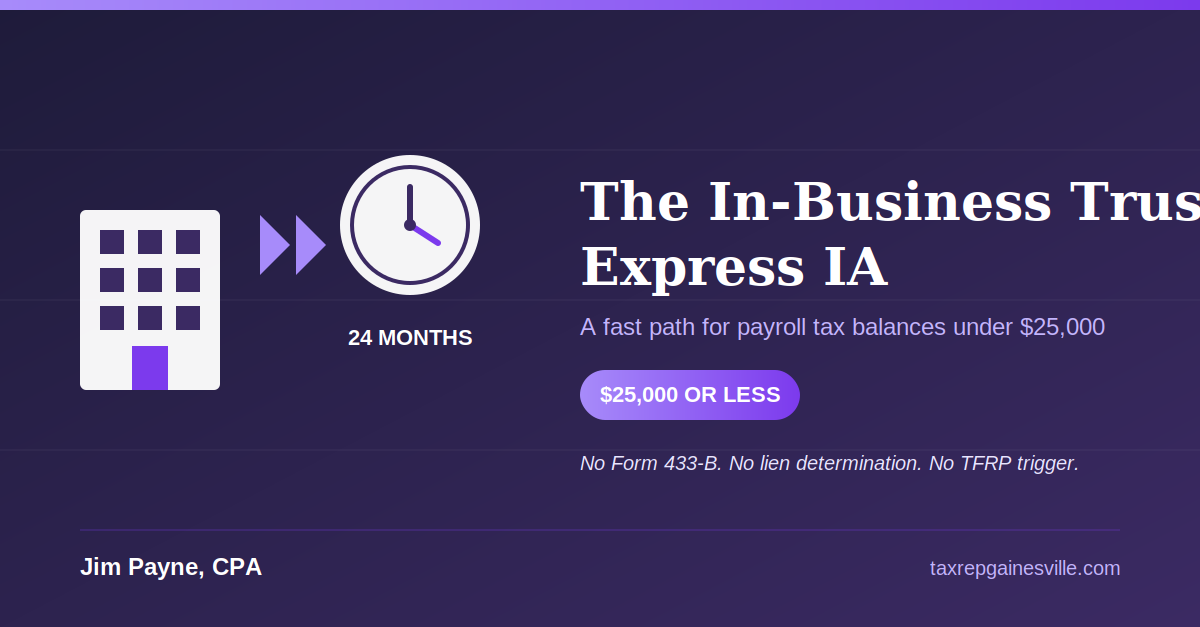
The In-Business Trust Fund Express Installment Agreement: A Fast Path for Small Payroll Tax Balances