The RCP Expense Tables Are Guidelines, Not Caps
This is a subtitle for your new post

Practitioners treat the National and Local Standards tables like a hard ceiling because that's how they function most of the time—plug in family size and zip code, get a number, and move on. But the IRM is explicit that the tables are a starting point, not a final answer.
Start with what "allowable" actually means. IRM 5.15.1.8(1) defines the necessary expense test: allowable expenses are those necessary to provide for a taxpayer's and their family's health, welfare, and/or production of income. That's the threshold everything else in this section is built on — an expense doesn't have to fit inside a standard-table number to be allowable; it has to satisfy this three-part test.
From there, IRM 5.15.1.8(6) is explicit about how the tables themselves function: "National and local expense standards are guidelines. If it is determined a standard amount is inadequate to provide for a specific taxpayer's basic living expenses, allow a deviation. Require the taxpayer to provide reasonable substantiation and document the case file."
That single sentence is the basis for every legitimate deviation argument in an OIC or installment agreement financial analysis. The problem isn't that the mechanism doesn't exist — it's that building the record for it takes more work than accepting the table number, so it gets skipped.
The Statute Requires This, Not Just the Manual
This isn't just IRS internal policy that could be waived away as unfavorable. IRC 7122(d)(2) requires the Service to publish national and local allowance schedules that ensure a taxpayer seeking to compromise a liability has adequate means to provide for basic living expenses. The guideline framework in IRM 5.15.1 is how the IRS implements that statutory requirement — which is exactly why it has to allow for deviation. A schedule that couldn't flex for atypical circumstances wouldn't guarantee "adequate means" for every taxpayer it applies to.
Two Different Mechanics, Not One Rule
The National Standards and the Local Standards don't work the same way, and conflating them is where many RCP calculations go wrong.
National Standards (food, clothing, housekeeping supplies, personal care, miscellaneous) function as a floor. Per IRM 5.15.1.9(2), the taxpayer may claim the full standard amount for their family size regardless of what they actually spend—no substantiation required. If the taxpayer wants to claim more than the standard in one of those categories, IRM 5.15.1.9(3) requires substantiation only for the specific category exceeded, not the entire schedule.
Local Standards (housing and utilities, transportation) work in the opposite direction — they function as a cap. Per IRM 5.15.1.10, the allowable amount is the lesser of the standard or the amount the taxpayer actually spends. If actual housing costs exceed the local standard, that excess isn't automatically disallowed, but it does require an affirmative deviation argument with documentation — the taxpayer doesn't get the higher number just by asking.
Getting this backward — treating National Standards as something requiring wall-to-wall receipts, or treating Local Standards as automatically allowable at actual cost — produces an RCP calculation that doesn't match how the IRM actually structures the analysis.
The Limit on Deviation Arguments
Deviation isn't a blank check, and the IRM draws the line clearly. IRM 5.15.1.8(8) states that a deviation is not allowed merely because it would be inconvenient for the taxpayer to dispose of valued assets or reduce excessive expenses to a standard level. The deviation mechanism exists for hardship, not for preference — a taxpayer doesn't get a housing deviation because they don't want to move; they get one because moving would create a documented hardship.
For housing specifically, IRM 5.15.1.10.1(3) lists the factors relevant to a deviation argument: the cost of the move itself, any increased transportation cost created by relocating to lower-cost housing, and the tax consequence of losing a Schedule A mortgage interest or property tax deduction. That last one is easy to overlook and can matter — a forced move to a standard-compliant rental can create a real net cost once the lost itemized deduction is factored in, and that's a legitimate input into the deviation analysis rather than a taxpayer complaint to be waved off.
This Runs Straight Through to RCP
None of this is academic once an OIC is on the table. IRM 5.8.5.20 incorporates the same guideline framework directly into the future income calculation that drives Reasonable Collection Potential — the expense analysis isn't recalculated from scratch for offer purposes; it's built on the same National and Local Standards mechanics described above, deviations included.
It also matters that the deviation record gets built at the right stage. IRM 8.23.3, governing Appeals' evaluation of rejected offers, requires that any allowance in excess of national or local standards be documented in the Appeals Case Memorandum. In practice, that means substantiation has to happen at the examiner level, in the case file, before the offer is ever rejected — showing up at Appeals with a deviation argument for the first time is a weaker position than building the record when the financial analysis is first prepared.
Why This Matters for Referral Sources
When a business owner's personal RCP looks worse than it should — a larger residence driven by a disability accommodation, a long commute that's a condition of the job rather than a choice, uninsured dependent health costs that don't fit neatly into the standard categories — the fix isn't arguing with the table. It's building the documented deviation record the IRM itself provides for in 5.15.1.8(6), substantiating the specific hardship, and getting it into the file before the analysis is finalized rather than as a rebuttal after the fact. Referral sources whose clients have atypical living-expense circumstances often leave RCP-reducing arguments on the table because the standard deviation mechanism isn't part of the standard playbook.


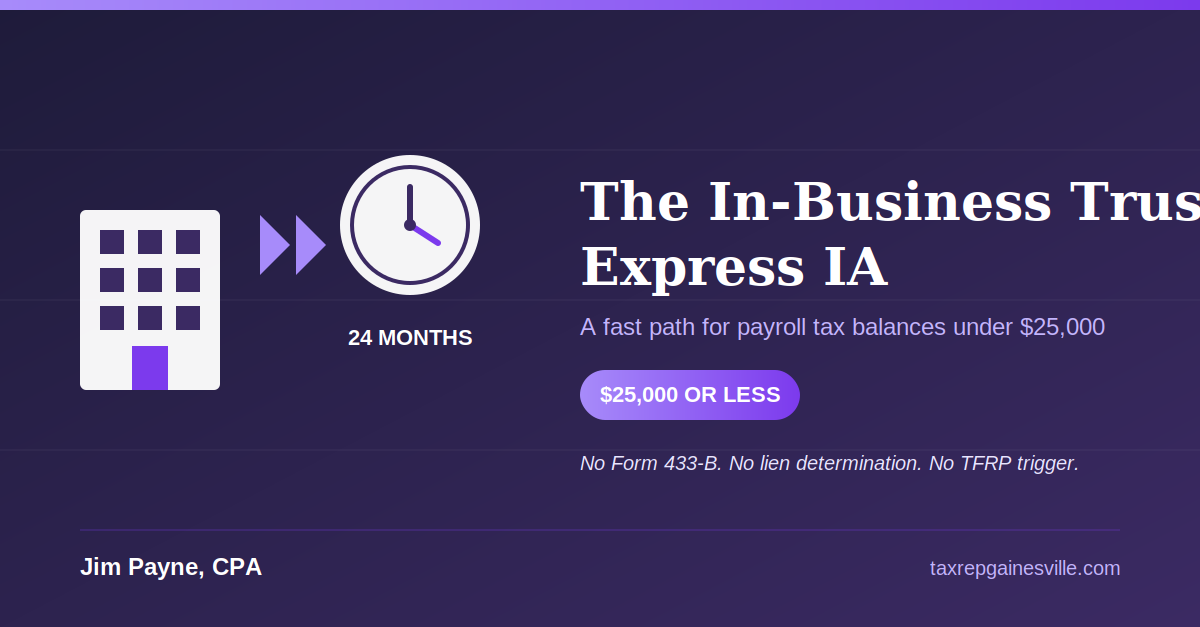
The In-Business Trust Fund Express Installment Agreement: A Fast Path for Small Payroll Tax Balances