Innocent Spouse Relief: What Happens to Collection While It's Pending
This is a subtitle for your new post

A Form 8857 filing changes the collection posture for one spouse, not both — and the distinction matters immediately in a divorce case where one spouse is trying to get out from under a joint liability the other spouse created. IRM 25.15.8 governs how a revenue officer handles a case once a request for relief is in the system, and the mechanics are more specific than "collection stops."
The Requesting Spouse Gets Protection; the Non-Requesting Spouse Doesn't
IRC 6015(e)(1)(B), as implemented in IRM 25.15.8.7(1), generally prohibits levies, seizures, and judicial collection proceedings against the requesting spouse while a claim for relief is pending. But IRM 25.15.8.7.2.2 is explicit that collection continues against the non-requesting spouse for the same tax years—the claim doesn't touch that spouse's exposure at all. For a divorcing couple, this means the spouse who didn't file the 8857 can still face a levy or a new lien filing while their ex-spouse's claim works through Cincinnati.
Two things the prohibition on the requesting spouse's side does not cover:
- Refund offsets. IRM 25.15.8.7(1)(a) confirms refund offsets aren't statutorily prohibited — the IRS has simply made a policy decision not to offset refunds while a claim is pending. That's discretion, not a rule, and it matters if a client is counting on a refund coming through during the process.
- Jeopardy situations. If the Territory Manager determines collection is in jeopardy, IRM 25.15.8.7(4) allows continued collection action against the requesting spouse despite the pending claim.
The CSED Suspension Isn't Just "Paused"
IRM 25.15.8.6(1) suspends the CSED for the period collection is prohibited, plus an additional 60 days. That suspension runs from the date the claim is filed until the earliest of three events: a signed Form 870-IS waiver, the expiration of the 90-day window to petition Tax Court after a final determination, or—if a petition is filed—the Tax Court decision becoming final. On a non-mirrored module, IRM 25.15.8.6.2.1(2)-(3) requires the CSED to be calculated separately for each spouse, and the manual is explicit: the CSED is not extended for the non-requesting spouse. Two different statute dates can be running on what looks like one liability.
An Existing Installment Agreement Doesn't Get Touched Automatically
If the Requesting Spouse (RS) already has an installment agreement in place when the 8857 is filed, IRM 25.15.8.7.1.3(2) directs the revenue officer not to unilaterally default it because of the pending claim. The RS must affirmatively decide whether to maintain, renegotiate, or default—and the RO's job is to make sure the RS understands the consequences of each choice before that decision is made, not to act on the RO's own initiative.
The Non-Requesting Spouse Has Appeal Rights Too
This is the piece most often missed: appeal rights under IRM 25.15.8.2.4 run both directions. The requesting spouse can appeal a denial. The non-requesting spouse can appeal a grant — in whole or in part. If a divorce settlement assumed a spouse's innocent spouse claim would resolve a joint liability cleanly, and the other spouse contests that outcome, the case isn't necessarily over when CCISO issues its preliminary determination. The administrative appeal window is 30 days from the preliminary determination letter; if it goes further, the requesting spouse has 90 days from a final determination letter to petition Tax Court.
Liens Stay in Place While the Claim Is Pending
IRM 25.15.8.11.1(1)-(2) is direct: Advisory will not release or modify a Notice of Federal Tax Lien until a relief determination is made, and the original NFTL remains in force in the meantime. A new NFTL can still be filed against the non-requesting spouse alone during this period. Only after a full-relief determination does IRM 25.15.8.11.2.1 trigger a partial release specific to the requesting spouse's name — the original lien itself isn't released, and the non-requesting spouse remains subject to it.
Why This Matters for Referral Sources
For a family law attorney structuring a settlement around one spouse's innocent spouse claim, three things shouldn't be assumed: that collection has stopped against the other spouse, that the CSED is running the same way for both parties, and that a favorable determination is final once CCISO issues it. The non-requesting spouse's appeal rights, in particular, can extend a case well past where a settlement agreement assumed it would close, which matters for anyone timing a divorce decree around resolution of a joint liability.
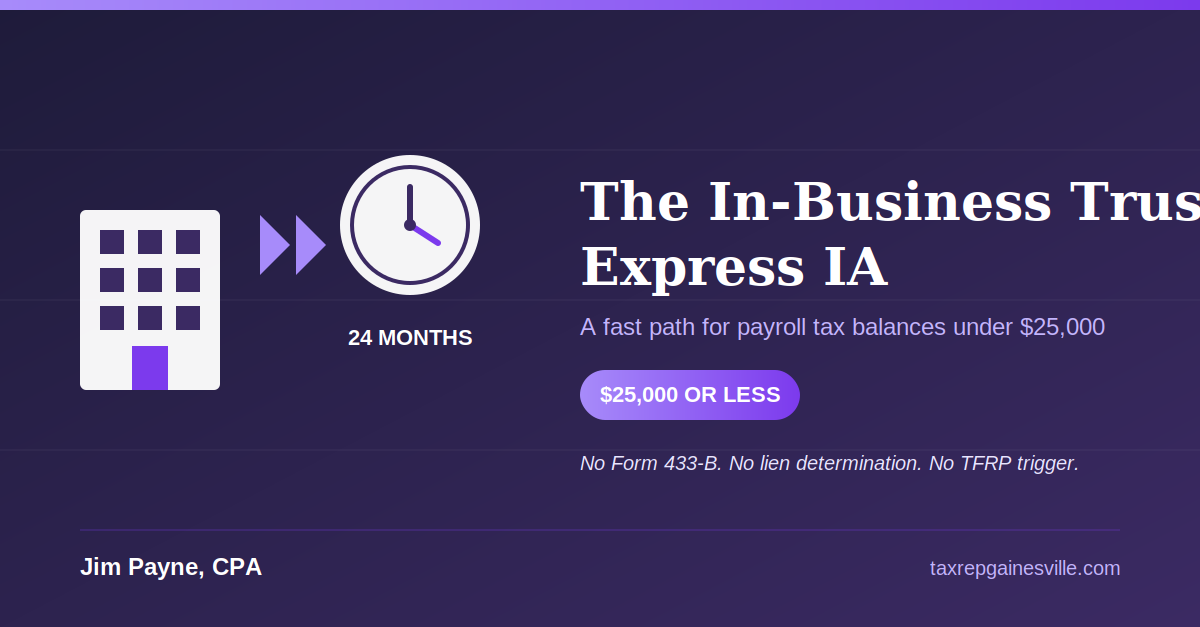
The In-Business Trust Fund Express Installment Agreement: A Fast Path for Small Payroll Tax Balances