When a Bad Bank Account Number Crashes a Direct Debit Installment Agreement
This is a subtitle for your new post

The client did everything right. Financials submitted. Agreement approved. Direct debit set up.
Then the first payment never comes out. A digit in the account number was wrong — maybe on the form, maybe in the IRS's input. Nobody notices until a default notice shows up.
Here's the uncomfortable part: the IRM has no special lane for this. The IRS treats a payment it can't pull like a payment that wasn't made. Speed, documentation, and knowing which procedure to use save the agreement.
Why a Paperwork Error Becomes a Default
Direct debit installment agreements (DDIAs) are the IRS's preferred payment plan. IRM 5.14.10.4(1) calls them the method with the lowest cost and the lowest rate of default.
The bank information is captured on Form 433-D. The account number and routing number are required fields — or a copy of a canceled check is attached (IRM 5.14.10.4(7)(b)). That form gets scanned and sent to campus for input (IRM 5.14.10.4(8)).
Two hand-offs. Two chances for a transposed digit.
When the debit fails, the account shows an unpaid installment. IRM 5.14.11.3(1) lists failure to pay an installment when due as the first reason the IRS may propose termination. The IRM doesn't distinguish between a taxpayer who skipped a payment and one whose payment was never collectible because the account number was wrong. I looked for a provision that excuses a default caused by bad bank data and didn't find one.
The Notices and the Clock
Watch for two things in the mail:
- A notice that a DDIA payment couldn't be processed. The IRS uses CP166 when a DDIA withdrawal fails, and its taxpayer page warns the agreement may be canceled.
- The default notice itself. CP 523 from the campus, or Letter 2975 in field cases (IRM 5.14.11.7(2)).
Once the default notice is mailed, the taxpayer has 30 days to act. The IRM gives a cushion on enforcement: no levy on the periods in the agreement for 90 days after the CP 523 or Letter 2975 is mailed (IRM 5.14.11.4(5)). That's breathing room, not a reason to wait. The 30-day appeal window is the deadline that matters.
Step One: Find Out Whose Error It Was
This drives everything else.
Pull these and compare them digit by digit:
- The signed Form 433-D (or the Form 9465 or online application, if that's how the DDIA was set up)
- The canceled check, if one was attached
- The client's actual bank account and routing numbers, confirmed with the bank
- IRS transcripts showing the agreement and the failed payment
If the form was right and the IRS keyed it wrong, that's an IRS error, and the file should prove it. If the form itself had the wrong number, it's the taxpayer's error — still fixable, but the argument changes.
Step Two: Cure the Default and Fix the Bank Data
Don't wait for the agreement to sort itself out. It won't.
Make the missed payment now, through Direct Pay or EFTPS, so the account is current. Then update the bank information as the IRM requires. Changing the bank, the routing number, or the account number on a DDIA takes a new Form 433-D signed by the taxpayer — and the group manager, if one is involved (IRM 5.14.11.5(7)). A phone call to update the number isn't enough under that paragraph.
Keep proof of everything: the payment confirmation, the corrected form, and the date it went in.
Step Three: Know What Reinstatement Will Cost
If the agreement does terminate, reinstatement isn't automatic. IRM 5.14.11.5(2) allows reinstatement without managerial approval or financial analysis in only two situations:
- The default came from a new liability that adds no more than two monthly payments and doesn't push past the CSED
- The agreement meets streamlined criteria, and the taxpayer hasn't defaulted an agreement in the prior 12 months
Everything else requires a fresh financial statement analysis to re-evaluate ability to pay (IRM 5.14.11.5(3)).
That's the real risk for larger balances. A non-streamlined agreement that took weeks of financial work to negotiate can be reopened in full because of one wrong digit. New financials, new expense review, possibly a higher payment.
Step Four: Use CAP When the Default Shouldn't Stand
If the cure doesn't hold the agreement — or the IRS error put the client in a worse spot — appeal.
The right to appeal a proposed termination is statutory. The taxpayer has 30 days from the CP 523 or Letter 2975 to file Form 9423, Collection Appeal Request (IRM 5.14.11.7(2)). No manager conference is required first for installment agreement appeals (IRM 8.24.1.3(10), Note). And there's a second chance: after termination takes effect, another 30 days to appeal. But it's one appeal — if you appeal the proposed termination, you can't appeal again once it terminates (IRM 8.24.1.3.4(1)).
Appeals look at whether the action was appropriate based on law, policy, and all the facts and circumstances (IRM 8.24.1.2(5)(c)). A default traced to an IRS input error — with a correct signed Form 433-D in the file and the missed payment already made — is a facts-and-circumstances argument worth putting in front of Appeals. That's a normal use of CAP, not an escalation.
The Side Issues: Penalties and Bank Fees
Dishonored payment penalty. IRC 6657 applies to electronic payments, not just checks. Per the IRS, the penalty is the lesser of the payment or $25 for payments under $1,250, and 2% at $1,250 or more. The IRS doesn't charge it when you made the payment in good faith and had reasonable cause to believe it would clear. If it appears on the transcript, request relief in writing with supporting documents. IRM 20.1.10.7 covers this penalty and its relief provisions.
Bank fees. If the bank charged the client because of an IRS error, the IRS can reimburse fees incurred solely because of that error, with a claim filed within one year (IRM 5.14.10.4(11)). If the error was on the taxpayer's side, the IRS's position is that the fee is between the client and the bank.
Why This Matters for Referral Sources
A crashed DDIA is a procedural problem with a short fuse. The fix is rarely complicated, but the order matters: confirm whose error it was, cure the missed payment, correct the bank data on a new Form 433-D, and file CAP inside the 30-day window if the default shouldn't stand.
The stakes rise with the balance. For a streamlined agreement, reinstatement is usually simple. For a larger, negotiated agreement, a default can reopen the entire financial analysis. That's the part worth protecting.
If a client brings you a CP166, CP 523, or Letter 2975, get it to me while the clock is still running. When a CAP appeal is the right move, I take the case to Appeals.
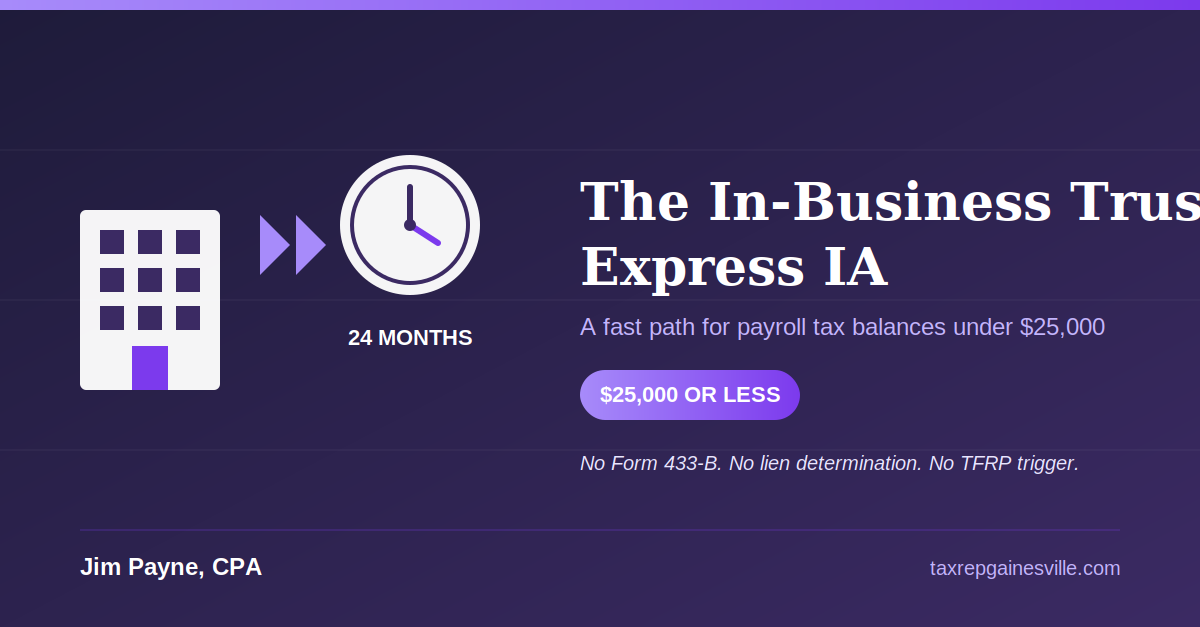
The In-Business Trust Fund Express Installment Agreement: A Fast Path for Small Payroll Tax Balances