5 Signs Your Client Needs an IRS Specialist — Not Later, Now
This is a subtitle for your new post

Most IRS problems don't arrive as emergencies. They start quietly — a letter the client mentions in passing, a balance due that gets pushed aside, a payroll deposit skipped once and then twice. By the time the situation lands on your radar, it has often gone further than it needed to.
As a Florida attorney or tax preparer, you're not expected to know the IRS collection procedure inside out. But recognizing when a client's situation has crossed into specialist territory can protect your client, your relationship with them, and your own liability exposure. Here are five signs that a referral call should happen now, not later.
1. The client received a CP503 or CP504 notice.
These are not routine IRS correspondence. A CP503 is a second reminder of an unpaid balance. A CP504 is a notice of intent to levy — the IRS's final warning before it seizes state tax refunds and begins the process of levying bank accounts and wages. Clients routinely ignore these because they look like junk mail. By the time they mention it to you, the window to act may be days, not weeks.
2. The balance owed exceeds $50,000.
At this threshold, the IRS transfers the case to its Automated Collection System with broader enforcement authority, or assigns it to a Revenue Officer for field collection. The options for resolution don't disappear, but they narrow — and the IRS becomes less flexible the longer the balance goes unaddressed. Early intervention at this level consistently produces better outcomes than waiting.
3. Multiple years of returns are unfiled.
Every year that goes unfiled gives the IRS the right to prepare a Substitute for Return on your client's behalf — always calculated in the government's favor, with no deductions, no credits, and no consideration of actual circumstances. Once those substitute returns are filed, collection begins automatically. This situation is fully resolvable, but only if someone addresses it before the IRS does.
4. Payroll taxes are involved.
Unpaid payroll taxes are among the most serious IRS problems a business owner can face. The Trust Fund Recovery Penalty holds responsible individuals personally liable for the employee portion of unpaid taxes — meaning the debt follows the owner even through bankruptcy and cannot be discharged. If your client's business has payroll tax problems, their personal financial situation is already at risk, whether they know it or not.
5. A Revenue Officer has made contact.
A Revenue Officer is an IRS field collection agent. Their assignment to a case is not a coincidence — it means the IRS has flagged the account for active enforcement. When a Revenue Officer enters the picture, the timeline for a negotiated resolution compresses significantly. This is the single clearest signal that a referral call should happen the same day.
Every one of these situations has a path forward. Offers in Compromise, installment agreements, currently not collectible status, penalty abatement, and collection appeals are all available tools — but they require someone who works in IRS representation every day to deploy them correctly.
If a client situation sounds like anything described above, I'm happy to talk through it at no charge. That conversation costs nothing and takes 15 minutes. It may save your client from an outcome that's very difficult to undo.
Jim Payne, CPA | Former IRS Agent | IRS Representation Specialist Florida statewide | (352) 317-5692 | taxrepgainesville.com/for-professionals
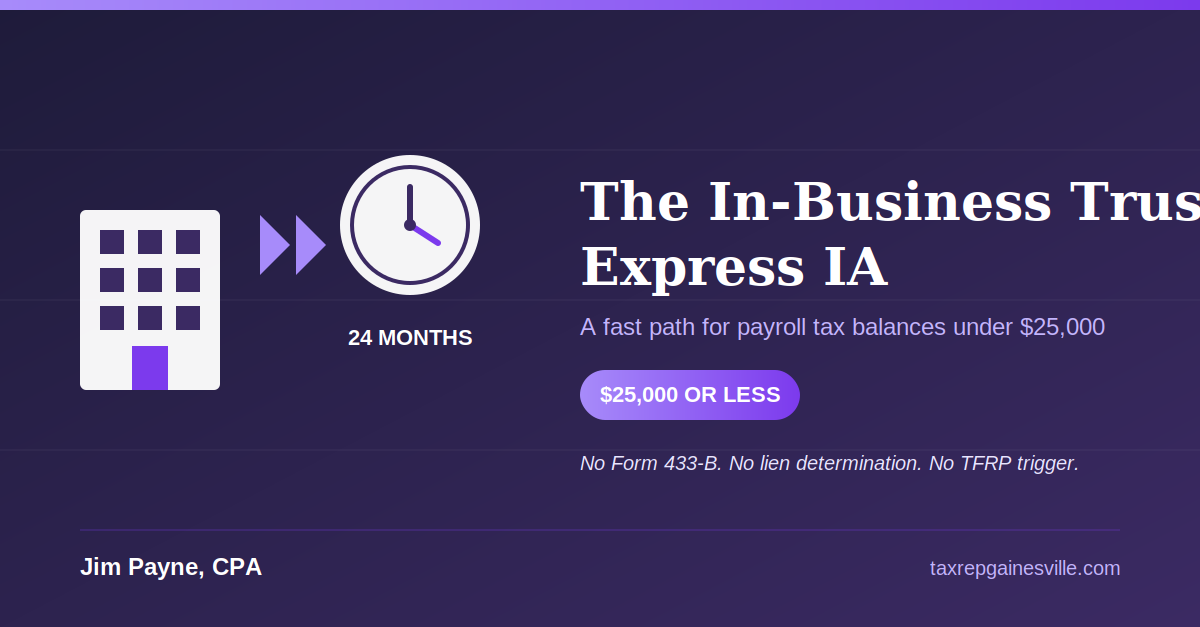
The In-Business Trust Fund Express Installment Agreement: A Fast Path for Small Payroll Tax Balances