Why Most People Aren’t Ready for an Offer in Compromise
This is a subtitle for your new post

One of the most common questions I hear is simple: “Can I get an Offer in Compromise?”
People have heard that the IRS sometimes settles tax debt for less than the full amount owed. They want to know if that option applies to them. What they often don’t realize is that an Offer in Compromise isn’t something you apply for first. It’s something you arrive at after the facts are clear.
Most people who ask about an Offer in Compromise aren’t ready—not because they don’t qualify, but because the groundwork hasn’t been done yet.
Compliance Comes Before Settlement
The IRS will not seriously consider an Offer in Compromise unless required tax returns are filed and current obligations are being met. If returns are missing, the IRS doesn’t have a complete picture. It cannot evaluate an offer based on partial information. Filing isn’t optional—it’s the foundation. Until compliance is established, settlement isn’t even part of the conversation.
This is where many people get ahead of themselves. They focus on settlement before establishing the facts that determine whether settlement is possible.
Eligibility Depends on Financial Reality
An Offer in Compromise is not based on how much someone owes or how difficult the debt feels. It’s based on whether the IRS believes it can collect more by waiting than by settling now.
That determination comes from financial analysis.
Income, expenses, assets, and future earning potential all factor into the calculation. If the IRS concludes that the balance can be paid over time—even slowly—it has little incentive to accept less.
Without reviewing those numbers, there is no way to know whether an offer is realistic.
Timing Matters More Than People Expect
Even when an Offer in Compromise makes sense, timing matters.
Getting ahead of the IRS gives you time to analyze your financial situation and, in some cases, make changes that can favorably impact the IRS’s calculation of your reasonable collection potential. Once enforcement escalates, those opportunities become more limited.
Submitting an offer before compliance is established, before financial conditions stabilize, or before the IRS posture is understood can lead to rejection—not because settlement was impossible, but because the case wasn’t ready.
An offer is strongest when it reflects a complete and accurate financial picture.
An Offer in Compromise Is a Conclusion, Not a Starting Point
People often think of an Offer in Compromise as a strategy. It isn’t. It’s the result of analysis.
Only after returns are filed, financial reality is clear, and the IRS posture is understood, does it make sense to consider settlement. Before that point, talking about an Offer in Compromise is premature.
The right question isn’t “Can I apply for an Offer in Compromise?” It’s “Do the numbers support one?” Answering that requires analysis first. Without it, an Offer in Compromise is just a possibility—not a plan.

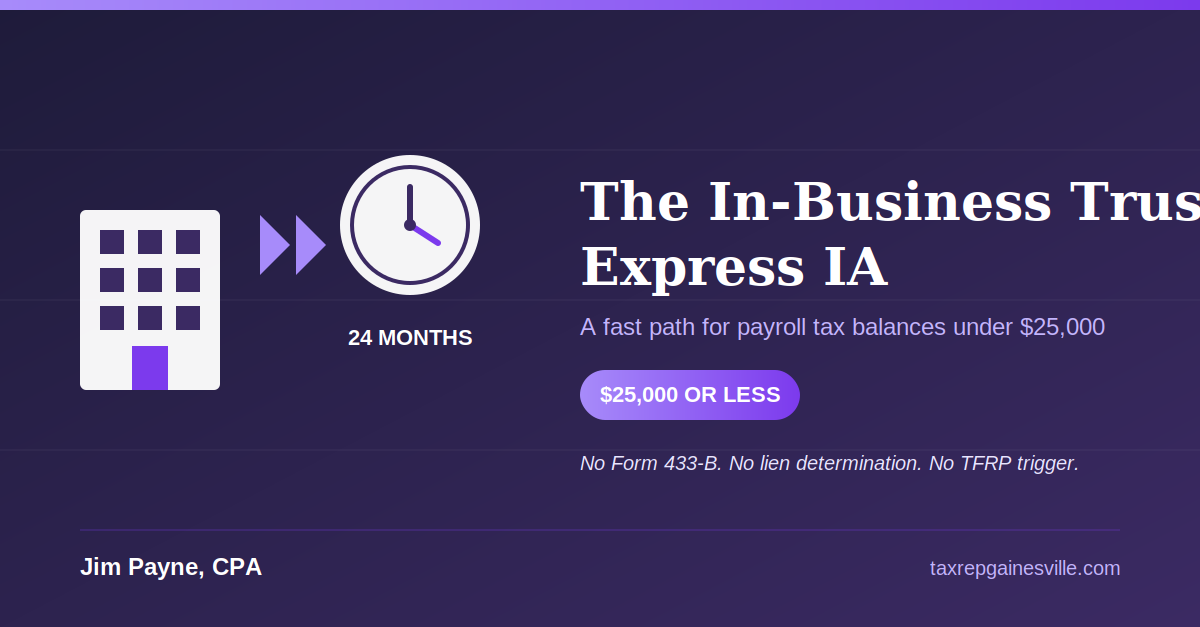
The In-Business Trust Fund Express Installment Agreement: A Fast Path for Small Payroll Tax Balances