COVID Tax Penalties: File for a Refund Before July 10
This is a subtitle for your new post

If you were hit with IRS penalties or interest during the COVID-19 pandemic years, there is a strong legal argument that some — or all — of those charges should never have been assessed. A recent federal court decision has opened a narrow window to recover that money, but most taxpayers have until July 10, 2026 to file a claim. For the 2019 tax year, the deadline may already be here.
Here is what you need to know.
The Law the IRS Has Been Ignoring
Congress enacted IRC §7508A(d) to address exactly this situation. The statute requires that the COVID-19 disaster period be disregarded when computing penalties, interest, and additions to tax. The language is mandatory — the word used is "shall."
Despite that clear command, the IRS continued running its assessment machinery throughout the pandemic, charging penalties and interest as though the disaster period never happened.
Two federal courts have now said that was wrong.
In Abdo v. Commissioner, 162 T.C. 148 (2024), the U.S. Tax Court held that §7508A(d) is unambiguous, self-executing, and mandatory. The IRS's own regulations to the contrary were invalidated. In Kwong v. United States, 179 Fed. Cl. 382 (2025), the Court of Federal Claims confirmed the disaster period ran from January 20, 2020 through July 10, 2023, and rejected the IRS's attempt to cap the relief at one year.
What Penalties Are Covered?
The statute covers "the amount of any interest, penalty, additional amount, or addition to the tax." Courts have read that broadly. Potentially recoverable charges include:
- Failure-to-file penalties (§6651) — 5% per month, capped at 25%
- Failure-to-pay penalties (§6651) — 0.5% per month, capped at 25%
- Failure-to-deposit penalties (§6656) — affects employers who made payroll tax deposits during the disaster period
- Trust Fund Recovery Penalty interest (§6672) — interest that accrued during the disaster window
- Estimated tax penalties (§§6654/6655) — installments due within the disaster period
- Information return penalties (§§6721/6722) — fixed-dollar penalties on Forms W-2 and 1099
- Partnership and S-Corp late filing penalties (§§6698/6699)
One important exclusion: FBAR penalties under 31 U.S.C. §5321 are assessed under Title 31, not the Internal Revenue Code, and are not covered.
How Much Money Are We Talking About?
The numbers can be significant. For a taxpayer who owed $100,000 in 2019 taxes, the combined failure-to-file and failure-to-pay penalties alone could reach $25,000. For an employer with $5 million in quarterly payroll, the failure-to-deposit penalty can exceed $500,000 per quarter. Even smaller cases add up quickly once you factor in interest compounding daily over three-plus years.
A new law — P.L. 119-64, signed December 26, 2025 — extended the lookback period for these claims, meaning cases that practitioners assumed were time-barred may now be viable again.
The Deadline Is July 10, 2026
The claim is filed on Form 843, Claim for Refund and Request for Abatement. Under IRC §6511(a), claims must generally be filed within three years of the return filing date or two years from payment. With the extended lookback under P.L. 119-64, most tax years 2019 through 2022 can still be reached — but July 10, 2026 is the outer boundary established by the Kwong decision for most claims. For 2019 specifically, filing by April 30, 2026 was recommended to allow margin — if you haven't filed yet, file immediately.
If the IRS denies the claim (you'll receive a Letter 105C or 106C), you have 30 days to protest to IRS Appeals, and two years from the denial date to file a refund suit in federal court.
What If You're Already in an Installment Agreement?
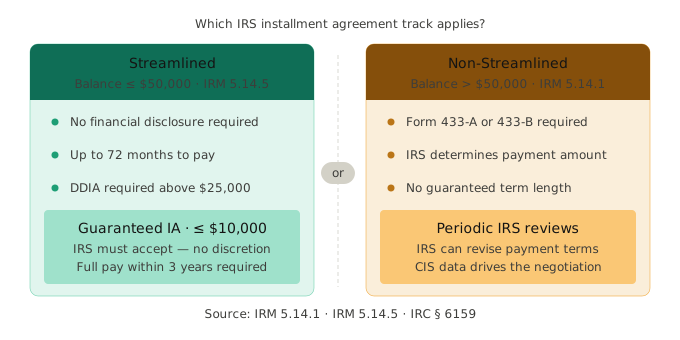
Filing Form 843 does not terminate an active installment agreement. If the claim is granted, you can request that any refund be applied to your remaining balance or returned to you directly. I can help coordinate that outcome.
Don't Leave This Money on the Table
This is one of the most significant penalty-relief opportunities I have seen in my career, and most taxpayers don't know it exists. The IRS is not going to reach out and offer to recalculate your penalties — you have to file the claim.
This post draws on legal analysis and framework developed by Frank Agostino, Esq., Counsel to Kostelanetz LLP and President of the Taxpayer Assistance Corporation, as published in the TAC Journal of Tax Controversy (2026). All legal positions should be verified by qualified tax counsel before filing.
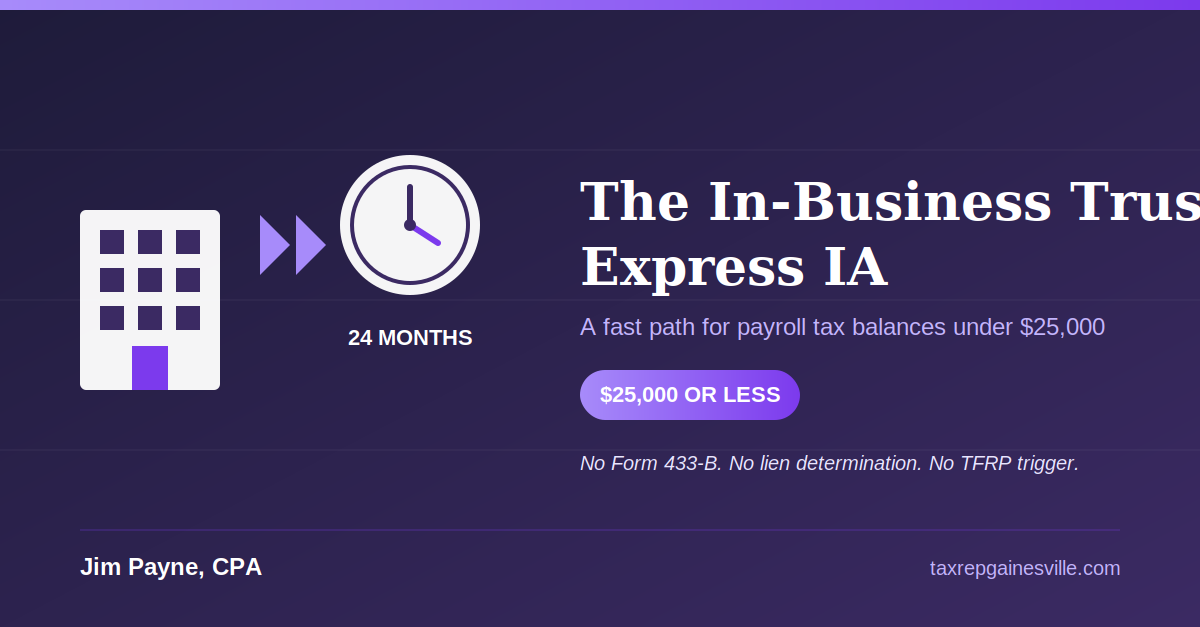
The In-Business Trust Fund Express Installment Agreement: A Fast Path for Small Payroll Tax Balances