When Your Client Gets a CP504: What to Do Before the IRS Levies
This is a subtitle for your new post

When a client walks in with a CP504 notice, the clock is already running. Most attorneys and preparers recognize it as serious, but there's meaningful confusion about exactly where it falls in the IRS collection sequence — and what it actually authorizes the IRS to do. Getting that wrong costs clients time and options.
Here's what you need to know.
What the CP504 actually is
The CP504 is the IRS's Notice of Intent to Levy under IRC §6331(d). It notifies the taxpayer of unpaid taxes and states that if the balance is not paid immediately, the IRS can levy income, bank accounts, and other property — and will begin searching for additional assets on which to issue a levy. Internal Revenue Service
That sounds final. It isn't — but it's close, and the distinction matters.
The IRS cannot levy with just the CP504. Before proceeding with most levy actions, it must first issue a formal Notice of Intent to Levy and Your Right to a Hearing, which is the next step after the CP504. That final notice advises the taxpayer of the right to a Collection Due Process hearing with the IRS Independent Office of Appeals before any levy action is taken. Internal Revenue Service
In practice, the CP504 is the warning shot. The LT11 (or Letter 1058) that follows is what triggers the formal CDP clock. Many practitioners make the mistake of waiting for the LT11 before acting. That's a mistake. The CP504 is the time to engage.
What the CP504 does authorize immediately
Immediately upon issuance of the CP504, the IRS can levy the taxpayer's state tax refund. It may also serve as a Disqualified Employment Tax Levy or a Federal Contractor Levy without further notice. These are narrow but real — and clients owed a state refund can lose it quickly. Taxpayer Advocate Service
Where this fits in the IRM
IRM 5.19.4 governs enforcement action and sets out the levy process. Under IRM 5.11.1, pre-levy actions require that the IRS first satisfy advance notice requirements. Under IRC §6330, the Notice of Intent to Levy and Notice of Your Right to a Hearing must be given in person, left at the dwelling or usual place of business, or sent by certified or registered mail to the taxpayer's last known address — not less than 30 days before the first levy. Internal Revenue Service
That 30-day window after the LT11 is the CDP window. Miss it, and the right becomes an equivalent hearing — still available, but with fewer protections, including no Tax Court appeal rights.
What to do when your client brings you the CP504
The first priority is determining where the account stands. Pull a tax transcript (Form 4506-C or e-Services) and confirm the balance, any prior notices issued, and whether the IRS has already filed a Notice of Federal Tax Lien (NFTL). A lien arises as a claim against all of the taxpayer's property once the balance is assessed and unpaid — it affects the ability to sell assets or obtain credit. Internal Revenue Service
From there, the path depends on the client's financial picture:
- If the client can full-pay, do it. There's no more effective resolution strategy than zero balance.
- If full payment isn't possible, an installment agreement or Partial Pay Installment Agreement needs to be in place — or at minimum in process — before the LT11 arrives.
- If there's a legitimate doubt-as-to-liability issue, document it now. CDP is the vehicle to raise it, but the facts need to be developed before the clock expires.
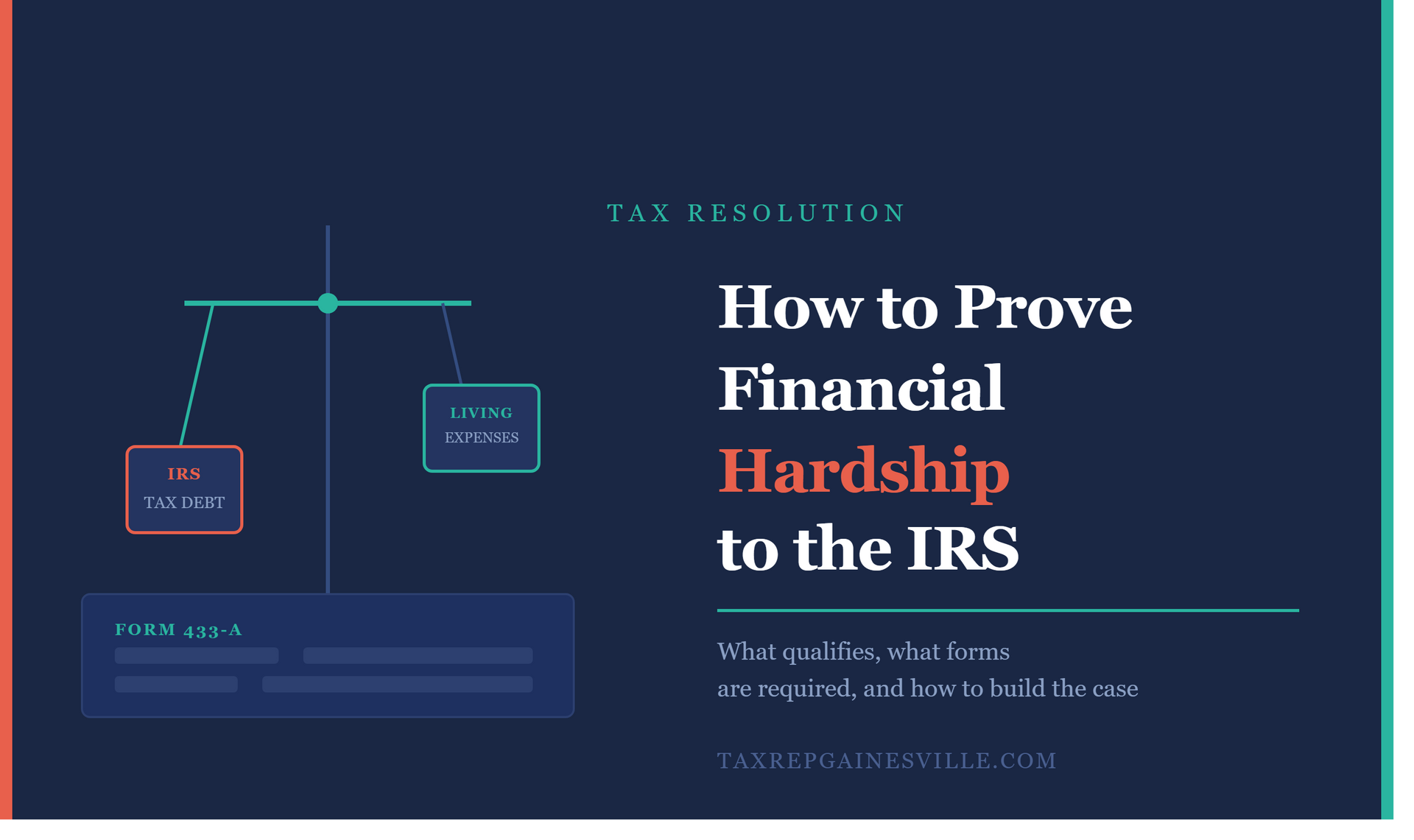
- If the client is in financial hardship, a Currently Not Collectible request under IRM 5.16.1 may be appropriate. The IRS will generally suspend enforcement of collection while a CNC determination is pending, provided the request is properly supported by a Collection Information Statement (Form 433-A or 433-F).
The referral decision
If your client has a balance over $10,000 and no current resolution in place, the CP504 is typically the point at which the matter should be referred to a tax resolution specialist. Collection cases that reach levy require active IRS representation — transcript analysis, financial statement preparation, and often direct negotiation with ACS or a revenue officer. That's a different practice area than compliance, and the stakes of a misstep are real.
I work with small firm attorneys and CPAs throughout Florida on exactly these situations. If a client comes to you with a CP504 and no clear path forward, I'm glad to consult on the options and take the matter from there.
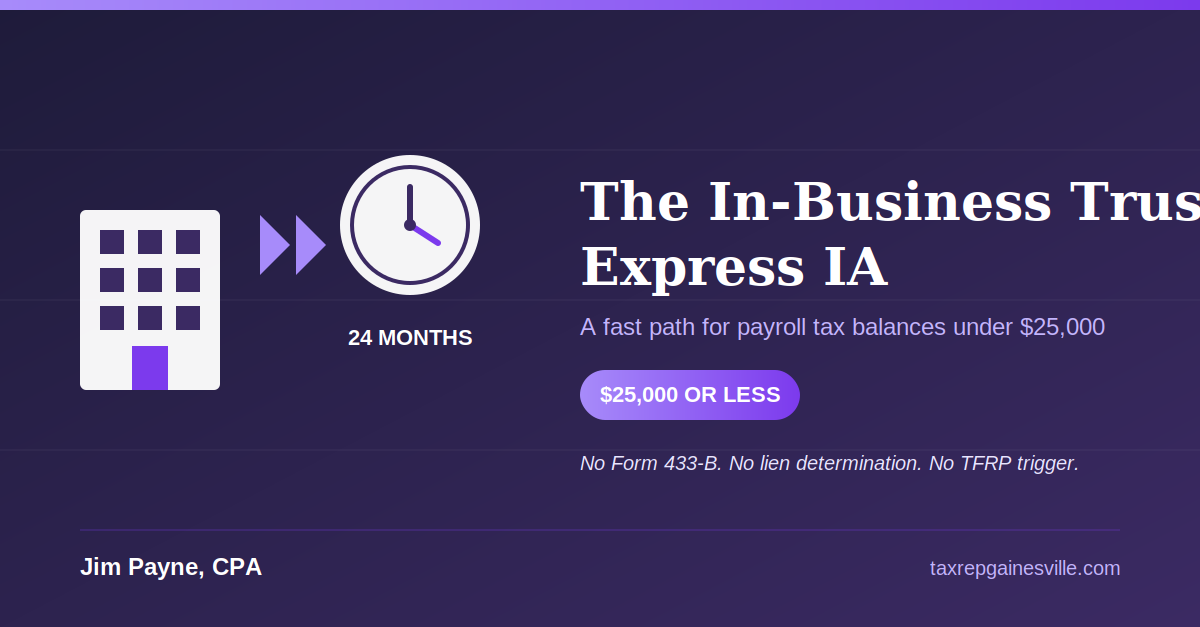
The In-Business Trust Fund Express Installment Agreement: A Fast Path for Small Payroll Tax Balances