Lien Paid, Closing Friday: How Long Does the Release Take?
This is a subtitle for your new post

The seller paid off the federal tax lien. Closing is Friday. The title company wants proof it's gone.
Here is the problem. Paying the lien and releasing the lien are two different events. The IRS has up to 30 days after the debt is satisfied to issue the release. Friday is not 30 days away.
The 30 days is a ceiling, not a schedule
The law gives the IRS 30 days to release a lien once the debt is paid in full, becomes legally unenforceable, or a bond is accepted. Most releases go out automatically, and the system checks for paid accounts weekly.
Then the release gets printed and mailed to the county. That happens twice a week. Then the county records it. Each step adds days.
Relying on the automatic process for a Friday closing is a gamble.
When the 30 days actually starts
The clock starts when the IRS treats the debt as paid. That depends on how the seller paid.
- Certified funds. Cash, cashier's check, certified check, official bank check, money order or Treasury check. The IRS can release immediately.
- Personal check. The 30 days starts only after 15 calendar days from receipt, to let the check clear. The seller can skip the wait by showing the canceled check.
- Electronic payment. The release waits until the payment has posted and is no longer pending. Proof of payment, such as the confirmation number, can get it released while the payment is still pending.
- Credit or debit card. No immediate release. The IRS waits out the chargeback period, up to 120 days for credit cards and 100 days for debit cards.
A personal check on a Monday is a lien that is still on the title the following Friday.
Asking for an immediate release
An immediate release is available. You must request it, and the debt must be paid in full by an approved method.
When it works, the IRS prepares the certificate of release and hands it over. The seller or the title company records it with the county and pays the county's recording fee. If the seller doesn't want to handle that, the IRS can record it through normal processing, but it is slower.
If no revenue officer is assigned, the request generally goes through a local Taxpayer Assistance Center. That means an appointment, so don't wait until Thursday.
Where these deals go sideways
- The payoff was short. Penalties, interest, and accrued costs all count. So can the lien filing fee assessed to the account. A few dollars in balance blocks the release.
- More than one tax period on the lien. One notice can cover several periods. The IRS issues the release only when every period on the notice is satisfied.
- Payments near year-end. A payment made right before or after January 1 can post late. You must request the release manually.
- Payment not showing on IRS transcripts. If the account doesn't show the payment, the IRS will want proof. Have the canceled check or confirmation ready.
- Release issued, not found at the county. It happens. The IRS can reissue it to the recording office, or the seller can record a copy.
What to do the day the payoff is made
- Pay with certified funds.
- Mark the payment as a lien payoff and include a copy of the lien notice.
- Request the release right away. Don't wait for the automatic process.
- Get the release recorded, or send a copy to the title company.
- If 30 days pass and nothing has been issued, the IRS should prepare the release manually. Push for it.
If the IRS misses its deadline and the seller loses money because of it, the law allows a claim for damages. That is a last resort, not a closing plan.
Why This Matters for Referral Sources
If you are an agent or a title agent, you see the lien on the title search, and you may hear "it's paid" a week before closing. Paid is not released.
The IRS sets the timeline, not me. What I can do is ensure the payoff is in a form the IRS accepts for immediate release, request the release the same day the payment goes in, and follow it through to the county records. The earlier I'm in, the more options there are.
If a lien shows up on a deal, call me the same day. Jim Payne, CPA, CTRC. (352) 317-5692.

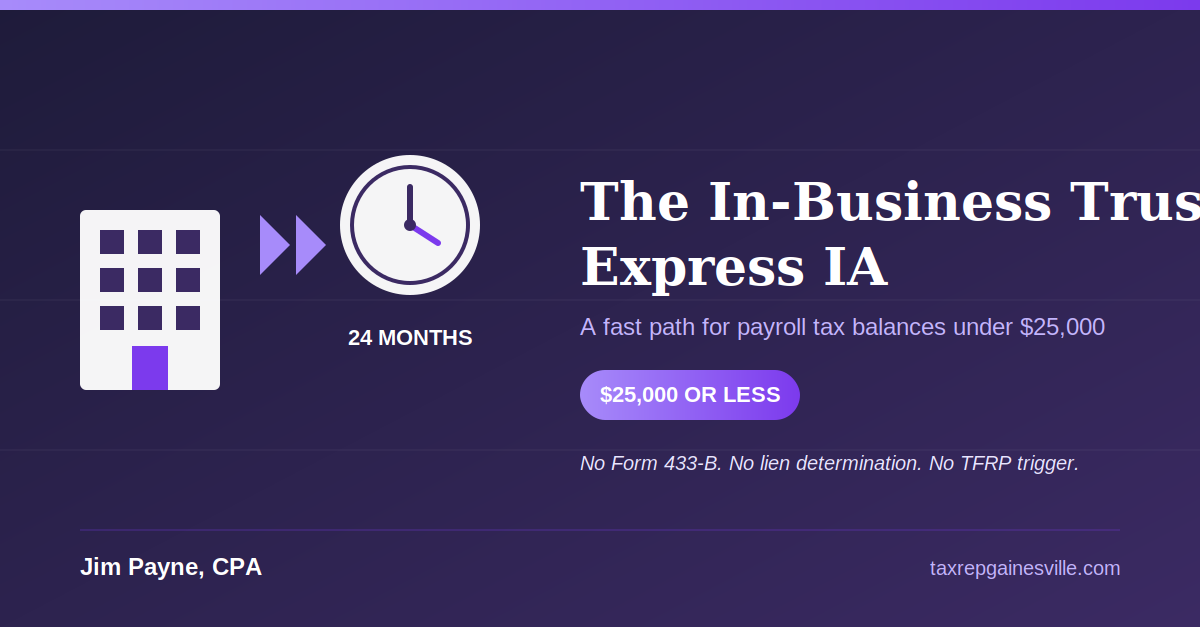
The In-Business Trust Fund Express Installment Agreement: A Fast Path for Small Payroll Tax Balances