Lien Release vs. Withdrawal: What Your Buyer’s Lender Sees.
This is a subtitle for your new post

Your seller says the tax lien is paid. The title search says otherwise. Both can be true.
The word "lien" covers two different things. One is the lien itself, the government's legal claim. And there is the public notice of that claim, which sits in the county records. A release and a withdrawal act on different pieces. Mixing them up is how a Friday closing turns into a Monday problem.
Two documents, two jobs
A release ends the lien. When the tax is paid, the collection period runs out, or a bond is accepted, the government has 30 days to issue a certificate of release. The county records that certificate where the notice was filed.
A withdrawal does something smaller. It pulls the public notice, and the notice is treated as if it was never filed. The debt is still owed. The lien is still there. The government's own guidance says the two cannot be used in place of each other.
One more point. A withdrawn notice costs the government its place in line against other creditors. That is why it does not hand out withdrawals freely.
How long a release really takes
The government has 30 days to issue a release. When that clock starts depends on how it was paid.
- Cash, cashier's check, certified check, or money order: the release can be issued right away.
- Personal check: the 30 days starts 15 days after the check is received. That is up to 45 days from the day the check went out.
- Electronic payment, including Direct Pay: no release until the payment has fully posted and can't be reversed. The payment usually shows up about 48 hours after it settles. A reversal can take up to five business days to appear. With proof of payment in hand, the release can be issued while the payment is still pending.
- Credit or debit card: the lien is held until the chargeback window closes. That is 120 days for credit and 100 for debit.
Then add mail time. Releases print and mail twice a week, and the county has to record the certificate after it arrives. Year-end payments can stall too. Payments made right before or during the first weeks of January can post late.
If the seller needs the release now, there is a faster path. In exchange for full payment in certified funds, the government can hand the certificate to the taxpayer to record. The taxpayer pays the county recording fee. That is how a release gets in the file before closing.
What the buyer's lender sees
The lender's title search reads the county records. It does not read a credit report. The major credit bureaus stopped carrying these notices in April 2018, but the notices are still public record and still effective.
After a release, the record shows the original notice, then the recorded certificate of release. The release ends the lien and invalidates any amended or refiled notices tied to it. The original notice is still in the file. It is just marked released.
After a withdrawal, the record shows the notice and the recorded withdrawal. The notice is treated as if it was never filed.
Whether a lender wants more than a recorded release depends on the lender and the title underwriter. I don't speak for them. What I can do is get the release issued and recorded, and tell you early if a withdrawal is realistic.
Withdrawal after release
A withdrawal after release is allowed. It is not automatic. The government generally grants it when four things are true:
- The request is in writing. Form 12277 is the usual way.
- The tax on the notice was fully satisfied.
- A certificate of release was issued.
- Returns for the last three years are filed, and current estimated payments and deposits are made.
Paid means paid. A lien that expired by statute or was discharged in bankruptcy does not count as fully satisfied for this purpose. A lien that simply expired and self-released is usually denied unless unusual circumstances apply, such as a license or a blocked loan.
Do not promise a withdrawal for a closing date. The internal targets add up to close to two months: about 30 days to review a complete request, 10 days to approve it, then up to 15 days to issue it to the recording office. The withdrawal also isn't entered until one print cycle after the release is generated.
If the seller asks for both at once, the government may issue the withdrawal in place of the release. But if the withdrawal can't be issued promptly, it must still issue the release within 30 days.
When the lien is not paid yet
A withdrawal does not fix an unpaid lien at closing. It is discretionary, and the government's guidance leans against giving up its priority in exchange for a promise to pay later. The manual even uses a refinance example. The lender wouldn't lend without a withdrawal; the borrower offered to pay from the new loan, and the answer was still no. Subordination was the better tool.
If the sale won't cover the lien, the tool is usually a discharge. If a refinance is stalled by a lien that stays, it is usually subordination. Those are separate posts in this series.
Why This Matters for Referral Sources
When a lien shows up, three questions will tell you where you stand.
- Was the lien paid in full? When, and how?
- Was it certified funds or a personal check?
- Is there a recorded certificate of release in the county file, or just a payment receipt?
If the release is overdue, or the notice is still in the county records after a release, we can fix it. It takes the right request to the right office, with proof of payment in hand. If the closing date is close, the earlier I see it, the more options there are.

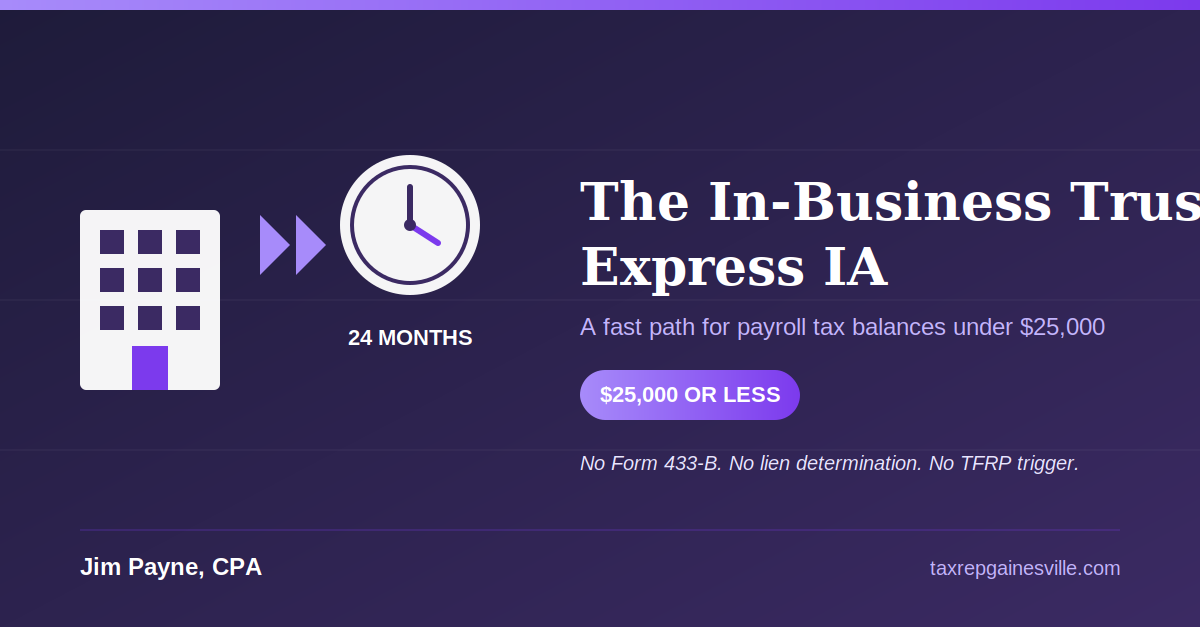
The In-Business Trust Fund Express Installment Agreement: A Fast Path for Small Payroll Tax Balances