Single-Owner Corps and OIC: The RCP Double-Count Problem
This is a subtitle for your new post

When a single-owner corporation owes back taxes, and the owner asks about settling via an Offer in Compromise, the instinct is to file a business OIC and call it done. That instinct is wrong — and the error is expensive. The IRS does not evaluate a single-owner corporation in isolation. Under IRM 5.8.5, the financial analysis for closely held entities creates a structural problem in which the same economic resources are counted against the owner twice: once on the corporate Form 433-B and again on the individual Form 433-A. Understanding how this works — and how to navigate it — is what separates a well-prepared submission from one that gets rejected, costing your client a nonrefundable 20% deposit.
Two Forms, One Economic Reality
A single-owner corporation filing an OIC submits Form 433-B(OIC) to establish the corporate RCP. If TFRP has been or is likely to be asserted against the owner individually — which is almost always the case when payroll taxes are involved — the owner simultaneously needs Form 433-A(OIC) for a separate individual OIC. The IRS processes these as independent submissions, but the examiner reviewing them is looking at the same underlying economic engine: one person, one business, one stream of income.
The double-count problem emerges in two places: officer compensation and corporate equity.
The Officer Compensation Squeeze
IRM 5.8.5 specifically addresses compensation in closely held entities. The examiner must evaluate whether officer compensation is reasonable. Compensation deemed excessive can be disallowed as a corporate business expense and added back into corporate income — directly increasing the corporate future income component of RCP and raising the minimum acceptable offer amount on the business side.
At the same time, that same salary is the owner's primary source of individual income reported on Form 433-A. It drives the individual future income value (FIV) calculation, net of ALE standards.
Here is the squeeze: if the owner's salary is set at a market rate — say, what a comparable outside manager would earn — the IRS may accept it as a reasonable corporate deduction. But it then flows in full into the individual RCP calculation. If the owner draws a modest salary and instead takes distributions, the IRS may recharacterize those distributions as income on the individual's side. Either way, the income gets captured somewhere. The question is where — and how much of it — gets double-counted across both submissions.
The Corporate Equity Problem
Under IRM 5.8.5, when an individual taxpayer has an interest in a closely held corporation, the examiner values that interest and includes it in the individual's asset RCP. The methodology: secure the corporate CIS, review tax returns, determine the net realizable equity (NRE) of corporate assets, and assign the owner's percentage share of that cumulative value as an asset on the individual 433-A.
For a 100% owner, this means all corporate equity — equipment, receivables, real property, goodwill in a going-concern business — flows into the individual RCP as an asset. It has already been captured in the corporate RCP via the Form 433-B. The IRS is not technically double-collecting (it can only collect the liability once), but when calculating the minimum acceptable offer amounts across both submissions, the same asset base is supporting two separate offer floors.
The practical result: the combined minimum offer across both submissions often substantially exceeds what the owner can actually fund.
The Goodwill Problem for Going-Concern Businesses
This is the most underappreciated element of corporate RCP in single-owner situations. The IRS can and does attribute goodwill value to an operating business for OIC purposes. A corporation that has been operating for years with a stable client base, recurring revenue, and brand recognition has goodwill — and under IRM 5.8.5's asset valuation framework, the examiner will attempt to quantify it.
For a CPA firm, a medical practice, a contractor with ongoing relationships, or any professional services business, goodwill valuation can significantly inflate both the corporate NRE and, through the equity attribution analysis, the individual RCP. Practitioners should be prepared to address goodwill methodology proactively, or the examiner's number will go unchallenged.
Coordination Strategy: What Actually Works
The goal in a single-owner situation is to present both submissions in a coordinated manner that accurately reflects the consolidated economic picture without inadvertently inflating either side.
Practical considerations:
First, determine whether simultaneous submission is appropriate. If TFRP has not yet been assessed, there may be sequencing value in resolving the corporate OIC first — an accepted corporate OIC covering the trust fund portion can moot or reduce the individual TFRP exposure before the individual offer is submitted.
Second, document officer compensation carefully. If the salary is reasonable and defensible by industry benchmarks, support it. The IRM explicitly uses ALE standards as a guide for evaluating officer pay in closely held entities, which is a low bar — use actual market compensation data instead and present it in the case history before the examiner develops their own number.
Third, address corporate equity attribution on the individual 433-A directly. Do not leave the examiner to independently value the owner's interest in the corporation without guidance. Present a documented NRE calculation for the corporate assets, apply the 80% quick-sale adjustment consistently, and show the math transparently. An undocumented corporate interest on the 433-A is an open invitation for the examiner to substitute their own valuation.
Fourth, dissipated assets require attention on both sides. IRM 5.8.5 allows examiners to add back asset values that were dissipated in the prior period. Corporate asset transfers, shareholder distributions taken while taxes were accruing, and equipment dispositions below FMV are all fair game on the 433-B. Personal asset transfers on the individual side face the same scrutiny.
When OIC Is Not the Right Vehicle
For a single-owner corporation that is still operating and generating positive cash flow, the combined corporate and individual RCP frequently exceeds what a realistic OIC can be priced at. In those cases, the more practical resolution may be a Partial Pay Installment Agreement (PPIA) under IRM 5.14.2 at the corporate level — which caps payments at current disposable income and expires at the CSED — combined with a separate individual installment agreement or currently not collectible (CNC) status on any assessed TFRP, depending on the owner's personal financial position.
The OIC is the right tool when RCP is genuinely less than the liability. In single-owner corporate situations, running that analysis rigorously before submitting anything — rather than relying on the Pre-Qualifier Tool — determines whether the OIC is viable or the client is about to fund a rejection and restart the clock.
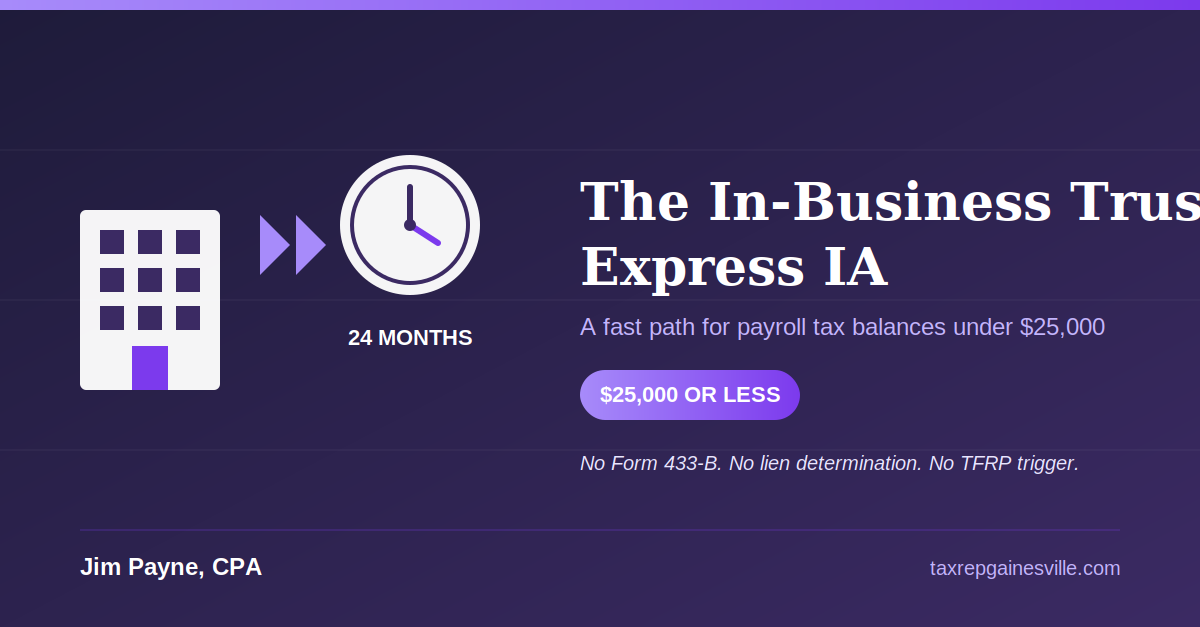
The In-Business Trust Fund Express Installment Agreement: A Fast Path for Small Payroll Tax Balances