When Income Averaging Helps You: Using Fluctuating Income to Lower Your IRS Settlement
This is a subtitle for your new post

If you owe the IRS and you’re considering an Offer in Compromise, you’ve probably heard this: “The IRS looks at your ability to pay.” That’s true—but what most people don’t realize is how they decide that. And more importantly:
In some cases, inconsistent or declining income can actually work in your favor—if handled correctly.
The Key Concept: RCP Isn’t Just About Today
When the Internal Revenue Service evaluates an Offer in Compromise, they calculate your Reasonable Collection Potential (RCP).
That includes:
- Your assets
- Your monthly disposable income
- Your future ability to pay
But here’s where it gets interesting: The IRS isn’t required to use a single snapshot of your income.
They’re trying to determine what’s realistic over time.
Why Fluctuating Income Can Actually Help You
Most people assume inconsistent income hurts their case. Not always. If your income is:
- Declining
- Unstable
- Seasonal
- Or tied to commissions/business cycles
You may be able to show that your true ability to pay is lower than your “best month” suggests.
Real-World Examples Where This Works
1. Business Owners in Decline
A business had strong revenue 1–2 years ago, but is now slowing. Instead of focusing on past highs, you can demonstrate:
- Reduced demand
- Loss of contracts
- Ongoing downward trend
Result: Lower projected future income → Lower RCP
2. Commission or Gig Workers
Income spikes in some months, drops in others. If the IRS only looked at a high month, it would distort reality. By showing a broader timeline, you can establish:
- True average income
- Volatility
- Lack of predictability
3. Seasonal Earners
Construction, tourism, and similar industries. Income may look strong for part of the year—but not consistently. The argument becomes:
“This isn’t sustainable year-round income.”
How “Income Averaging” Helps Your Case
While the IRS doesn’t formally say “we average your income,” in practice: They are trying to normalize your earnings. And when done correctly, that can:
- Smooth out inflated high-income periods
- Highlight declining trends
- Show limited future earning potential
The Strategic Advantage
Here’s the key insight most people miss: RCP is forward-looking. So if your income is trending downward—or unstable—you’re not stuck being judged on your best year. You can shift the focus to:
- What’s sustainable
- What’s likely going forward
- What you can actually afford long-term
Where This Goes Wrong
This only works if it’s credible. The IRS will push back if they believe:
- Income was intentionally reduced
- The decline is temporary
- The numbers don’t match the supporting documents
That’s where cases fall apart.
What Makes This Strategy Work
To use income variability in your favor, you need to:
- Show a clear pattern (not just one bad month)
- Provide supporting documentation
- Explain the why behind the fluctuations
- Demonstrate that the trend is ongoing
Final Thoughts
Most taxpayers worry that their past income will be used against them.
But in many cases, the opposite can be true. If your income is inconsistent or declining, you may be able to show the IRS that: Your real ability to pay is lower than it appears at first glance.
And when that’s done right, it can make a significant difference in how your case is evaluated—and what you ultimately have to pay.
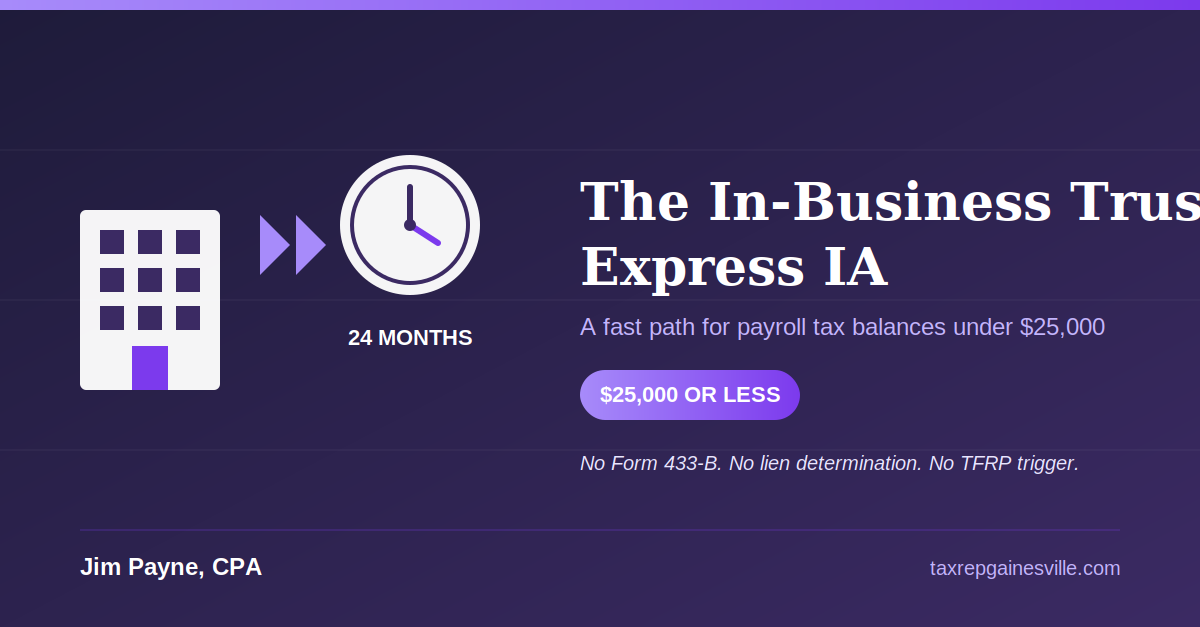
The In-Business Trust Fund Express Installment Agreement: A Fast Path for Small Payroll Tax Balances