When Bankruptcy Becomes the Right IRS Strategy
This is a subtitle for your new post

Bankruptcy is often viewed as a last resort. In IRS cases, that perspective can be misleading.
Like installment agreements, offers in compromise, or Currently Not Collectible status, bankruptcy is simply a tool. Whether it is appropriate depends on the financial facts and the timing of the case. The question is not whether bankruptcy is good or bad—it is whether it fits the situation.
Most IRS cases begin the same way. There is a balance owed, and the focus turns to payment plans or settlements. But those are not always the right solutions. If the financial analysis shows that the liability cannot realistically be paid—either now or over time—other options have to be considered. In some cases, bankruptcy becomes one of those options.
One of the key factors is the type and age of the tax debt. Certain income tax liabilities may be dischargeable in bankruptcy if specific timing requirements are met, while others—such as recent liabilities or payroll taxes—generally are not. Because of this, bankruptcy is not a universal solution. It is a fact-specific option that depends on the details of the case.
Even when tax debt cannot be discharged, bankruptcy can still play a role. It may eliminate other liabilities that are competing for limited income. Reducing those obligations can change the overall financial picture and make other IRS solutions more realistic. In that sense, bankruptcy is not always about eliminating the tax debt itself—it is about changing the context in which that debt is managed.
Timing can also significantly affect the outcome. Filing too early may mean that tax debt is not eligible for discharge, while waiting may allow the case to meet the required thresholds. At the same time, waiting too long can allow the IRS to escalate collection activity. The decision is not just whether to file, but when to file.
Bankruptcy is rarely the starting point in an IRS case. It is considered after the financial analysis is complete and the available options are understood. If the numbers show that payment is not realistic, and if the timing supports it, bankruptcy may become a logical part of the overall strategy.
In IRS matters, the goal is not to choose a preferred solution. It is to identify the approach that fits the financial reality and the case's timing. Sometimes that leads to a payment plan, sometimes to a settlement, and sometimes to Currently Not Collectible status. In some situations, it leads to bankruptcy—not as a last resort, but as the option that makes the most sense given the facts.
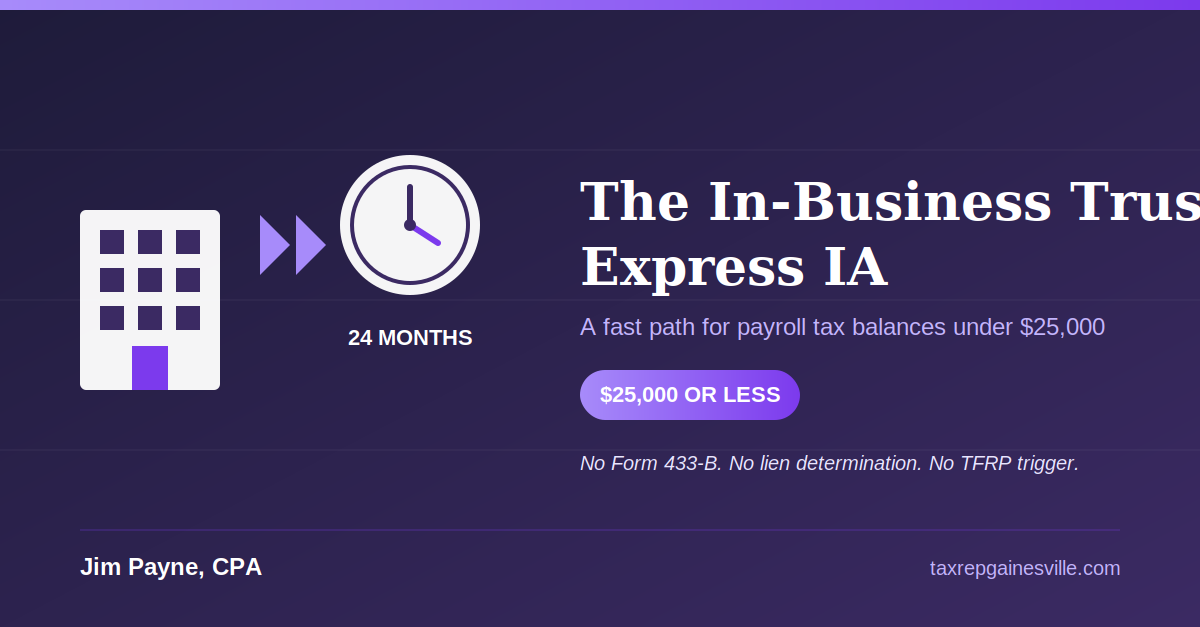
The In-Business Trust Fund Express Installment Agreement: A Fast Path for Small Payroll Tax Balances