The CDP Hearing: Your Client's Most Powerful — and Most Wasted — IRS Right
This is a subtitle for your new post

The Collection Due Process hearing is routinely described as a taxpayer's "last best chance" before the IRS moves to enforce collection. That description is accurate, but it undersells what a well-prepared CDP request actually accomplishes. Here is what IRM 8.22 provides — and where practitioners leave value on the table.
What Triggers CDP Rights
Under IRC §§ 6320 and 6330, CDP rights attach in two situations:
- The first Notice of Federal Tax Lien (NFTL) filed for a given tax period — the taxpayer receives notice within five business days of filing and has 30 days to request a hearing.
- A Final Notice of Intent to Levy (typically Letter 1058 or CP90) — the taxpayer has 30 days from the date of the notice.
IRM 8.22.4 governs the CDP program within Appeals. The key procedural point: a timely CDP request (within the 30-day window) suspends most levy action while Appeals reviews the case, and it preserves the right to petition the U.S. Tax Court if the taxpayer disagrees with the resulting Notice of Determination. An untimely request — filed within one year — results in an Equivalent Hearing (EH), which provides the same substantive review but does not require Appeals to halt collection and does not preserve Tax Court rights.
The difference between timely and untimely is often a matter of days. Know your client's notice dates.
What an Appeals Officer Can Do at CDP
IRM 8.22.5 and 8.22.7 set out the settlement officer's authority. At a CDP hearing, the taxpayer may raise:
- Whether the IRS followed required procedures (verified lien or levy is appropriate and legally authorized)
- Collection alternatives: installment agreements, currently not collectible status, Offer in Compromise, or partial pay installment agreements (PPIA)
- Spousal defenses (innocent spouse relief under IRC § 6015)
- Challenges to the underlying tax liability — but only if the taxpayer did not previously receive a statutory notice of deficiency or otherwise have a prior opportunity to contest the liability
That last point matters for practitioners whose clients received a CP2000 or audit assessment and simply ignored it. By the time the lien notice arrives, the liability challenge window at CDP may be closed.
The OIC-within-CDP Combination
IRM 8.22.7 specifically addresses OICs submitted as collection alternatives during CDP. This creates a strategic option that standalone OIC submissions do not provide: if Appeals rejects the OIC as part of CDP, the taxpayer retains Tax Court jurisdiction over the collection determination. A rejected standalone OIC — processed through IRM 5.8 — only carries the right to appeal to Appeals on Form 13711, with no Tax Court follow-on for the OIC itself.
For clients with genuine doubt as to collectibility and a concurrent collection threat, submitting the OIC as a CDP alternative rather than a standalone submission may be the stronger posture.
The Prohibited Levy Problem
A recent IRS interim guidance memorandum (AP-08-0825-0016, effective August 2025, incorporated into IRM 8.22.5) addressed a recurring problem: levies issued after a taxpayer filed a timely CDP request, in violation of the IRC § 6330 stay on enforcement. Appeals officers are now required to review transcripts for prohibited levies as part of initial case analysis. If you're handling a CDP case where a levy was attached shortly after the request was filed, check the transcript carefully — the IRS is now required to document and address those situations.
Common Practitioner Errors
- Filing Form 12153 to the wrong address (it must go to the address on the notice, not a general IRS office)
- Checking no alternative on Form 12153, which leaves the Appeals Officer with nothing to consider
- Failing to submit financials (Form 433-A or 433-B) before or at the conference
- Requesting CDP when the appropriate vehicle is the Collection Appeals Program (CAP) — CAP is faster and better suited for disputes about actions already taken (rejected installment agreement, improper levy), but provides no Tax Court access
Referral Considerations
CDP cases that involve significant balances, competing creditors, payroll tax components, or pending OICs are not routine. The 30-day window is unforgiving, the procedural record matters, and the Tax Court preservation issue is consequential. If a business client of yours has received a Final Notice of Intent to Levy or a lien notice and the balance is material, a referral to a specialist before that window closes is worth the conversation.
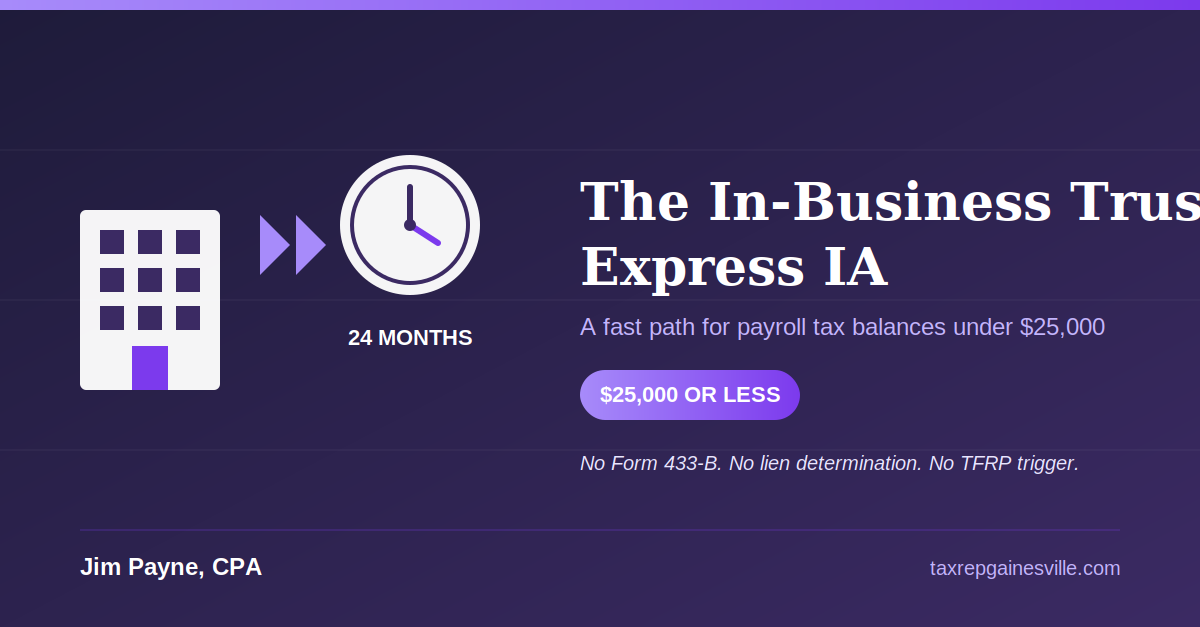
The In-Business Trust Fund Express Installment Agreement: A Fast Path for Small Payroll Tax Balances