Why a Paid Tax Lien Still Shows Up in the County Records
The seller says the tax lien is paid. The check cleared. The title search still shows the notice.
Most of the time, the debt is paid, and the paperwork hasn't caught up. Sometimes the lien isn't fully paid. The fix is different for each, so the first job is telling them apart.
The lien and the notice are two different things
The lien is the government's legal claim. The notice is the public filing that tells everyone about it.
Paying the debt ends the lien. It does not remove the notice. The public record changes when a release is recorded with the same office that took the notice.
Reason 1: The release is still in the pipeline
The government has 30 days to issue a release once the debt is satisfied. That is a deadline set by law, not a delivery date.
Between payment and a recorded release, the payment has to post. The lien office picks it up in a weekly update. The release prints and gets mailed to the county. Releases are printed and mailed twice a week. Then the county has to record it.
How the debt was paid changes when the 30 days starts. A personal check adds 15 days to the 30. Pay by certified check or Direct Pay instead. Certified funds can be released right away. Direct Pay waits only for the payment to post.
Reason 2: "Paid" doesn't mean paid in full
A release is issued only when everything on the notice is satisfied. Check these first:
- The amount on the notice is not the payoff. Interest and penalties keep growing, and accrued costs count too.
- The filing fee counts. If the tax is paid and only the fee is left, the release waits on the fee.
- One notice can list up to 15 separate assessments. Pay one tax year, and the notice stays. A release for a single year is issued only if someone asks for it.
- A payment plan is not payment. A seller who is current on a plan has not paid the lien.
Reason 3: The notice was filed in more than one place
A notice is filed where the property is. In Florida, the office depends on the type of property:
- Real estate: the clerk of the circuit court in the county.
- Personal property of a corporation, partnership, trust or estate: the Secretary of State.
- Personal property of an individual: the clerk of the circuit court in the county.
A release has to be recorded where the notice was filed. A clean county search does not clear a state filing, and the reverse is true too.
Refiled and amended notices add more filings. Releasing the original ends the related filings legally, but the general practice is to record a release for each one. If one is skipped, the record still shows it.
Reason 4: The lien expired and nobody recorded anything
IRS liens are "Self-Releasing". Most notices carry a "Last Day for Refiling." If the government doesn't refile by then, the lien is treated as released on its own.
No certificate is issued automatically. The seller has to ask for one. If the lien expired or was discharged in bankruptcy, the seller files it.
A careful reader can see the date on the notice. Not every bank or underwriter reads it that way. Some want a recorded certificate before they will treat the lien as gone.
The fix is to ask for the certificate, even though the lien released itself. If a lender still won't move, a withdrawal is possible but hard to get. The government generally grants one for a self-released notice only in unusual circumstances, such as a blocked loan or license.
Reason 5: The release exists but isn't in the record
A seller who pays with certified funds can get the release handed over right away. Then the seller has to record it and pay the county's fee. If nobody records it, the record doesn't change.
Sometimes the release is issued, and the county still can't find it. The lien office can reprint it and send it again.
One more trap. The copy the government mails the taxpayer does not show recording information. It is not proof the release was recorded. A recorded copy comes from the county.
How I sort out which one you have
I ask three questions:
- How and when was it paid? Certified funds, personal checks, and electronic payments run on different clocks.
- Does the IRS account transcript show the release was processed?
- Is a release recorded where the notice was filed?
If 30 days have passed with no release, I put the request in writing with proof of payment. If closing is close, I take the proof of payment to the local office. If the release was issued but never recorded, I get the lien office to send it again.
Why This Matters for Referral Sources
When a paid lien shows up on a title search, the useful question isn't whether it was paid. It's where the release is and whether it's recorded.
Ask the seller for three things: proof of payment with the date and method, the government's payoff or release letter, and a recorded copy from the county.
If any of the three is missing, call me the same day. These are timing problems. Timing problems can usually be solved if I see them early.
I work for the seller, since only the taxpayer can authorize me to deal with the government. But the call can start with you.
I'm a CPA and a Certified Tax Representation Consultant (CTRC). I work on the lien side of these deals, so your closing doesn't have to wait on it.
For the full guide, see Federal Tax Liens: What Each Fix Does and When to Use It

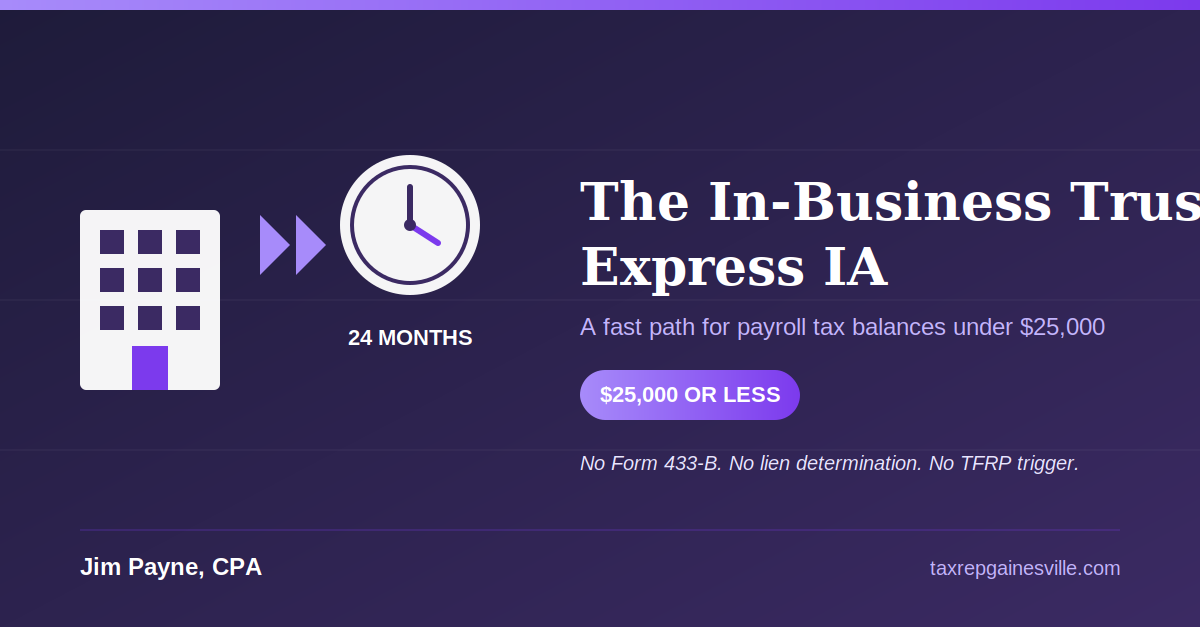
The In-Business Trust Fund Express Installment Agreement: A Fast Path for Small Payroll Tax Balances