Why Most Offers in Compromise Get Rejected
According to the IRS's most recent Data Book, the IRS received 33,591 Offers in Compromise last year and accepted 7,199 of them — roughly a 21% acceptance rate. I've reviewed enough of the rejected files to know the pattern behind that number. It's rarely a case the IRS was unwilling to negotiate. It's an offer that never had a real chance, for reasons that were preventable before it was ever submitted.
Here's what actually kills an Offer in Compromise, in the order I see it happen.
1. The Taxpayer Wasn't in Filing and Payment Compliance
Before the IRS evaluates a single dollar figure, it checks processability under IRM 5.8.2.3.1. An offer with unfiled required returns will be deemed not processable — generally covering a six-year lookback period without managerial approval to go further back. Business taxpayers get an added layer: the IRS checks federal tax deposit compliance for the two prior quarters and the current quarter before an offer is worked at all.
I see this constantly with business owner clients. They come to me wanting to settle a $150,000 payroll tax balance, but two quarters of 941s are still unfiled. The offer can't move until that's fixed. Filing compliance isn't a formality — it's a gate.
2. The Offer Was Below Reasonable Collection Potential
Once an offer is processable, the entire evaluation comes down to one number: Reasonable Collection Potential (RCP), governed by IRM 5.8.5. RCP isn't a starting point for negotiation — it's the IRS's calculation of net realizable equity in assets plus the value of future income, and offers below that number are rejected as a matter of course.
Two RCP mistakes show up over and over in files I inherit:
- Asset valuation disputes. Real estate, vehicles, and business assets are valued at Quick Sale Value under IRM 5.8.5.4.1 — generally 80% of fair market value, not the taxpayer's own estimate. If the file supports a value the IRS didn't use, that's a fight worth having; if it doesn't, the offer is under RCP by definition.
- Business interest and K-1 income. For S-corp, partnership, and LLC owners, IRM 5.8.5.8 requires the IRS to value the taxpayer's proportionate share of the entity's net realizable equity, and to scrutinize officer compensation, shareholder distributions, and undistributed K-1 income for reasonableness. An owner drawing a below-market salary while the business carries value gets that gap added back into RCP. I flag this early with every business owner client — it's one of the most common reasons a self-prepared offer from a business owner comes in too low.
3. A Collateral Agreement Was Refused
This one catches taxpayers off guard. Where the IRS anticipates a substantial future income increase or a business asset that's being depreciated, it can condition acceptance on a collateral agreement. Under IRM 5.8.6.2(6), refusing an appropriate collateral agreement can be independent grounds for rejection — coded Not in the Best Interest of the Government — even where the dollar amount offered would otherwise be acceptable.
If a client is close to a career change, a pending settlement, or a licensing shift that could spike future income, I address the collateral agreement question before the offer goes in, not after a rejection letter shows up.
4. The Appeal Doesn't Match the Rejection Letter
If an offer is rejected, the case isn't over — but the appeal has to be precise. Under IRM 8.23.3, the Independent Office of Appeals will sustain Collection's rejection only for the reason actually stated in the rejection letter signed by the appropriate delegated official. Collection's internal case notes and the rejection letter don't always agree — one basis documented internally, a different one stated to the taxpayer. That mismatch is often the strongest argument on appeal, stronger than re-litigating the RCP math from scratch.
What This Means Before You File
Every one of these failure points is addressable before submission:
- Confirm filing and FTD compliance first — don't submit an offer around an open compliance gap.
- Build the RCP calculation yourself before the IRS does, especially business asset and K-1 valuation.
- Flag any anticipated income increase and decide on collateral agreement strategy up front.
- If a prior offer was rejected, get the actual letter and compare its stated basis against the file before appealing.
I work with business owners carrying payroll tax and income tax balances over $100,000, and case strategy on OIC eligibility — including whether an offer is the right tool at all versus a Partial Payment Installment Agreement or Currently Not Collectible status — starts with this RCP math, not the settlement amount a client wants to offer.
If you have a client whose OIC needs a second look before or after submission, I'm glad to walk through the RCP calculation with you.
Jim Payne, CPA, CTRC (352) 317-5692 jim@taxrepgainesville.com
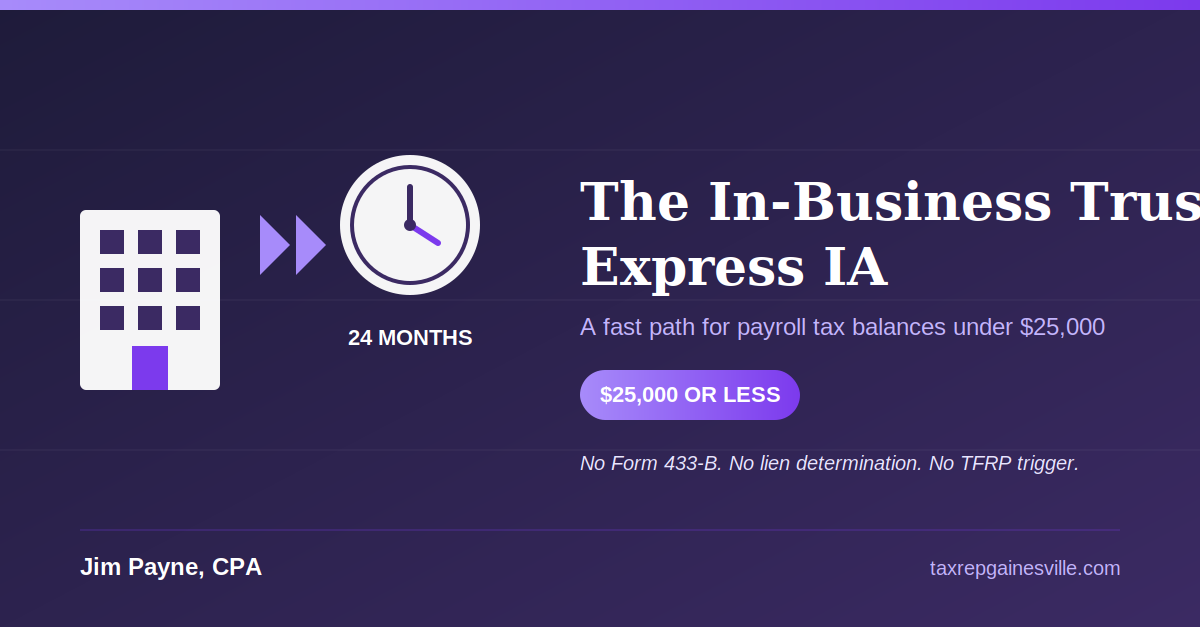
The In-Business Trust Fund Express Installment Agreement: A Fast Path for Small Payroll Tax Balances