Will the IRS File a Lien If I'm on a Payment Plan?
The short answer: It depends on the plan. A payment plan does not stop the IRS from filing a Notice of Federal Tax Lien. But a Simple Payment Plan, generally for balances of $50,000 or less, doesn't call for a lien decision at all. Bigger plans and partial-pay plans do. A lien can also go on if you default. If one is filed, a direct debit plan may get it withdrawn.
By Jim Payne, CPA, CTRC | Last reviewed: November 22, 2026
Does a payment plan stop the IRS from filing a lien?
No. The lien itself arises on its own once you're assessed, billed, and don't pay. The Notice of Federal Tax Lien is the public filing that tells lenders and buyers about it. That's the step I'm talking about here.
The IRS can file that notice while your plan request is pending, when it grants the plan, while it's rejecting one, and during a default or termination. The IRS manual says an agreement shouldn't be granted until the government's interest is protected, and that can mean filing.
Which plans skip the lien?
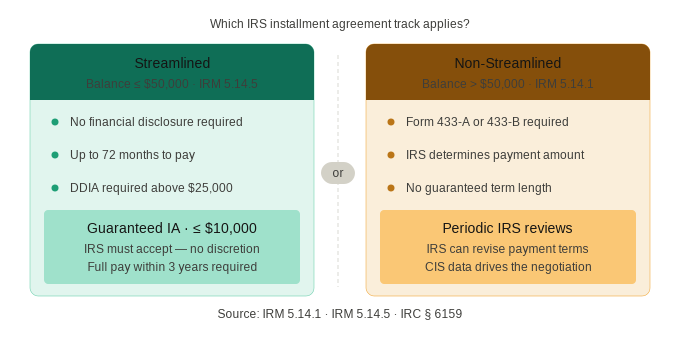
The IRS doesn't have to make a lien decision for three types of plans:
-
Simple Payment Plan. Generally $50,000 or less. This replaced what used to be called the streamlined agreement. I cover the change in Streamlined vs. Non-Streamlined IRS Installment Agreements. -
Simple Payment Plan for business trust fund balances. Generally $25,000 or less. -
Guaranteed installment agreement. Income tax of $10,000 or less.
A lien decision is required for the other types. That includes regular agreements for larger balances, partial-pay agreements, and in-business trust fund agreements that don't fit the simple track.
Separate from the plan type, the IRS generally files a lien when the unpaid balance is $10,000 or more. It generally doesn't file one under $2,500.
Can the IRS still file a lien after I'm on a plan?
Yes, but it's not the normal practice. The IRS manual says it takes group manager approval and should happen only in unusual situations. Selling assets or moving them out of reach are the examples it gives. A looming bankruptcy can also be a reason.
A default is the more common trigger. A missed payment can end the plan and open the door to a filing. I walk through that in What Happens When an IRS Installment Agreement Defaults.
If the IRS plans to file, it has to tell you first. You get a chance to pay in full or change the plan so it meets the rules for not filing. You can appeal a planned filing through the Collection Appeals Program. After a filing, you can ask for a hearing.
Can a payment plan get a filed lien withdrawn?
Sometimes. A withdrawal removes the public notice. It doesn't erase the debt. For a direct debit plan, the IRS looks for:
-
Balance: $25,000 or less. If you owe more, you can pay it down to $25,000 first. -
Payoff: the plan pays the debt in full within 60 months or before the collection deadline, whichever is earlier. -
Payment history: at least three consecutive direct debit payments have gone through. -
No defaults: no default on this or any earlier direct debit plan, unless the default wasn't your fault. -
Compliance: you're current on your filing and payment requirements. -
No earlier withdrawal: the IRS manual also asks that you haven't had a lien withdrawn on these debts before. -
Tax type: individuals, businesses with an income tax debt only, and out-of-business entities with any type of debt.
Other plan types don't qualify unless you switch to direct debit and meet the same rules.
You ask in writing, and Form 12277 is the preferred form. If I'm your representative, I send it with your signed authorization. Expect weeks. The IRS manual sets internal targets of about 30 days to make a recommendation on a complete request and 15 days to issue the withdrawal after approval.
If you default after a withdrawal, the IRS can file a new notice. Switching the plan away from direct debit can do the same.
What does this mean for a sale or refinance?
A filed notice shows up on title searches. A withdrawal takes it off the public record, which helps a closing. A plan alone doesn't clear a lien that's already filed.
For the basics, see How IRS Tax Liens Affect Your Options. For how a release differs from a withdrawal, see Lien Release vs. Withdrawal: What Your Buyer's Lender Sees.
Frequently asked questions
Will the IRS file a lien if I set up a payment plan?
 Not automatically. Simple Payment Plans and guaranteed agreements don't call for a lien decision. Larger and partial-pay plans do.
Can the IRS file a lien after I'm already on a plan?
 Yes. A default is the usual reason. The IRS can also file in unusual cases, such as a taxpayer moving assets out of reach.
Can a payment plan get my lien withdrawn?
 It can, if you're on a direct debit plan for $25,000 or less, you've made three consecutive payments, and you meet the other requirements.
Does a withdrawal erase my tax debt?
 No. It removes the public notice. You still owe the tax, and a default can bring a new notice.
Setting up a plan? Call me before you sign
The type of plan decides whether a lien gets filed. A few details, like direct debit or paying a balance down below $25,000, can change the result. Call me before you commit. Call (352) 317-5692 or visit taxrepgainesville.com.
Sources: IRC 6323(j); IRM 5.14.1.4.3, Notice of Federal Tax Lien and Installment Agreements (Payment Plans), 5.14.1.6 and Exhibit 5.14.1-5 (rev. July 20, 2026); IRM 5.14.5, Simple Payment Plans (rev. July 21, 2026); IRM 5.12.2.3.1 and 5.12.2.6, Notice of Lien Determinations (rev. July 12, 2024); IRM 5.12.9.3.2 and 5.12.9.3.2.1, Withdrawal of Notice of Federal Tax Lien (rev. Sept. 6, 2019); IRS, Understanding a Federal Tax Lien; Form 12277; Taxpayer Advocate Service, Withdrawal of Notice of Federal Tax Lien (updated Jan. 27, 2025).


The In-Business Trust Fund Express Installment Agreement: A Fast Path for Small Payroll Tax Balances