Why Most Offers in Compromise Are Rejected
This is a subtitle for your new post

When people hear about an Offer in Compromise, they often focus on the possibility of settling their tax debt for less than the full amount owed.
What they don’t hear as often is that most Offers in Compromise are rejected.
That isn’t because the IRS is arbitrary or unwilling to settle. It’s because the IRS applies a financial test, and many offers fail that test before they’re even submitted.
Understanding why offers are rejected helps explain what the IRS is actually evaluating.
The IRS Is Comparing Your Offer to What It Can Collect
An Offer in Compromise is not a traditional negotiation. The IRS does not ask what you want to pay. It calculates what it believes it can collect over time. This calculation is called the Reasonable Collection Potential formula, or RCP.
RCP reflects income, allowable expenses, asset equity, and future earning capacity. If the IRS believes it can collect more through monthly payments or enforcement than through settlement, it will reject the offer.
The decision is driven by financial analysis, not persuasion.
Compliance Problems Lead to Immediate Rejection
One of the most common reasons offers are rejected has nothing to do with the amount offered.
If required tax returns aren’t filed, or current tax obligations aren’t being met, the IRS will not consider a settlement. Compliance is a prerequisite. Without it, the offer cannot be evaluated.
This is why filing and financial analysis always come first.
Settlement Depends on What the IRS Believes It Can Collect
The IRS does not base settlement decisions on how much is owed. It bases them on how much it believes it can collect.
This determination depends on income, allowable expenses, asset equity, and future earning capacity. If those factors indicate the IRS can recover the balance through payments or enforcement before the collection statute expires, an offer will be rejected.
Settlement becomes possible only when the financial analysis shows that full collection is unlikely within the time the IRS has to collect. The deciding factor isn’t the size of the debt. It’s the gap between what is owed and what the IRS expects it can actually recover.
Timing and Preparation Matter
Some offers are rejected simply because they are submitted too early. Financial conditions may not yet reflect long-term reality. Compliance may be incomplete. Or the financial analysis may not fully account for how the IRS evaluates income and assets.
Getting ahead of the IRS gives you time to understand your financial position and, in some cases, make changes that affect how your collection potential is measured. Once enforcement escalates, those opportunities narrow. An offer is strongest when it reflects a complete and accurate financial picture.
Rejection Is Often Predictable
An Offer in Compromise should never be a guess. Before an offer is submitted, the financial analysis should already indicate whether the IRS is likely to accept it. When offers are rejected, it is often because that analysis was never done—or the conclusions were ignored.
The IRS isn’t rejecting the person. It’s rejecting the numbers.
Settlement Is the Result of Analysis, Not Hope
An Offer in Compromise can be an effective resolution tool when the financial reality supports it.
But it isn’t available simply because the debt exists. It becomes viable only when the numbers show that settlement is the most efficient outcome for the IRS.
That’s why preparation matters more than persuasion. The question isn’t whether the IRS is willing to compromise. It’s whether the financial analysis supports one.

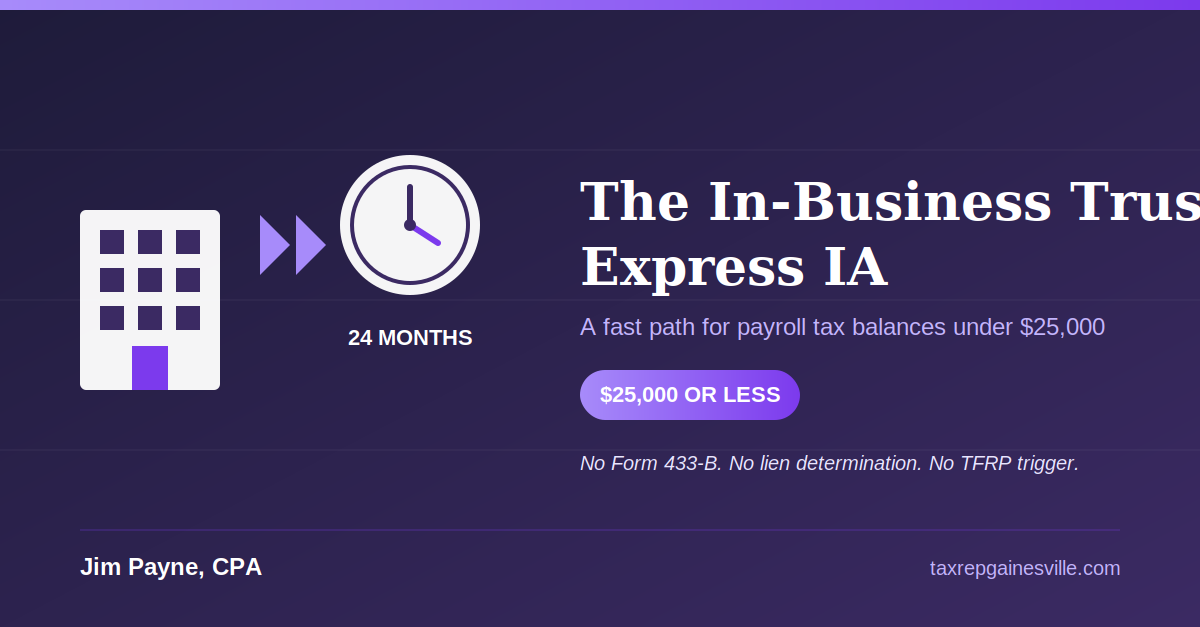
The In-Business Trust Fund Express Installment Agreement: A Fast Path for Small Payroll Tax Balances