IRS Installment Agreements: Why Most Payment Plans Fail
This is a subtitle for your new post

An IRS installment agreement often feels like relief.
Collection activity pauses. A monthly payment is set. For many people, that alone feels like progress.
But over time, many IRS installment agreements fail—not because the IRS changes the rules, but because the agreement no longer matches the taxpayer’s financial reality.
One reason this happens is that many payment plans are established quickly and under pressure. When the immediate goal is to stop enforcement, the focus often shifts to what will get approved rather than what can realistically be maintained over several years. The payment works at first, but it leaves little room for normal income fluctuations or unexpected expenses.
Eventually, something gives.
Why IRS Installment Agreements Commonly Default
The IRS’s own data reflects this pattern. According to the IRS Data Book for 2024, more than half of IRS installment agreements default within just a few years. While the Data Book does not assign a single cause, defaults most commonly occur because payments are missed or a new tax balance arises while the agreement is still in effect.
Installment agreements require ongoing compliance. All future tax returns must be filed on time, and all new taxes must be paid when due. One missed filing or one unpaid balance can terminate the agreement, even if prior payments were made consistently.
Another common issue is that people treat installment agreements as permanent arrangements. They aren’t.
When income drops or expenses increase, an IRS payment plan can often be renegotiated. The IRS allows modifications when financial circumstances change, but the request must be made proactively. Waiting until after a payment is missed usually results in default notices and a faster return to enforcement, making renegotiation more difficult than it needed to be.
Installment agreements also do not resolve the underlying tax debt. They spread payments over time while interest and, in some cases, penalties continue to accrue. That is not surprising to most people, but it does mean that poorly structured agreements can drag on for years without making meaningful progress on the balance.
From the IRS’s perspective, an installment agreement is a collection tool, not a long-term financial solution. The default rates shown in the IRS Data Book reflect that reality. Payment plans are expected to fail when they are based on assumptions that do not hold up over time.
IRS installment agreements can work when they are built on realistic numbers and actively managed. Most fail because they are treated as a finish line instead of what they really are: a flexible arrangement that needs attention when circumstances change.
Recognizing when a payment plan no longer fits—and addressing it before it breaks—is often the difference between staying in control and starting over under worse conditions.

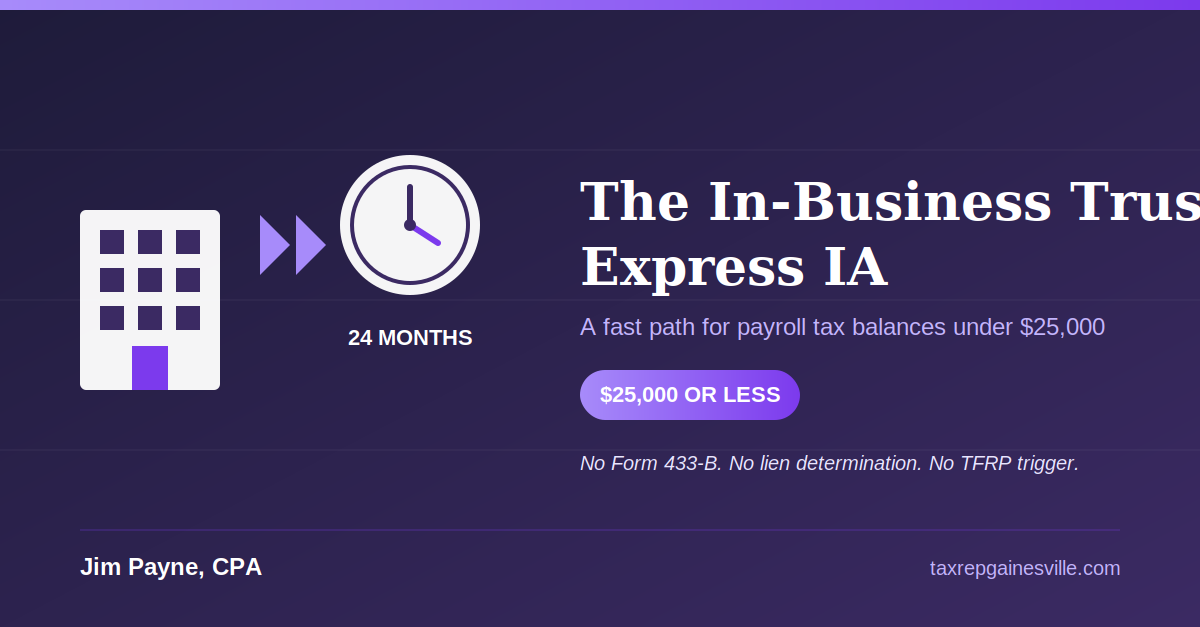
The In-Business Trust Fund Express Installment Agreement: A Fast Path for Small Payroll Tax Balances